Voters Link Crypto Rules to U.S. Financial Leadership
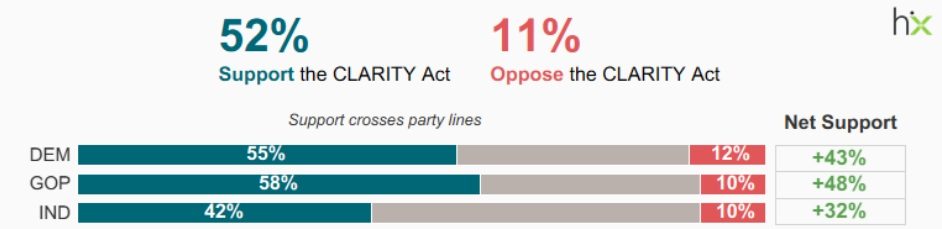
Harrisx, a public opinion research and polling firm, released a national survey on May 7 showing broad voter support for the Digital Asset Market Clarity (CLARITY) Act of 2025. The poll found 52% supported the bill after voters reviewed a policy summary of the legislation, while 11% opposed it. Harrisx surveyed 2,008 registered voters from May 1-4, 2026, with a margin of error of 2.2 percentage points.
Support for the CLARITY Act extended across political groups after voters reviewed a summary of the legislation. Republicans, Democrats, independents, and likely midterm voters all backed the bill by wide margins. Support was strongest among crypto owners, voters familiar with digital assets, and respondents already aware of CLARITY. Awareness of the legislation remained limited overall, with 64% saying they had not heard of the bill before the survey. Another 14% said they had heard a lot, while 22% had heard a little.
The survey noted:
“52% support the CLARITY Act after a neutral description; 11% oppose. Support is bipartisan, and the persuadable middle is large.”
Digital asset familiarity remains uneven, though crypto ownership has become politically relevant. Harrisx found 39% of voters are familiar with digital assets and blockchain technology, while 61% are not. Still, two in five voters have purchased crypto at some point, and 30% bought crypto in the past year. The survey found familiarity and ownership are concentrated among men and voters under 35. Separately, 70% said the United States should already have passed clear cryptocurrency legislation, while 60% preferred federal legislation over case-by-case enforcement.
National Security Message Drives CLARITY Act Support
Offshore market structure added urgency to the findings. Only one-third of voters knew eight of the 10 largest cryptocurrency exchanges are based outside the United States. After learning that, 46% said crypto trading beyond U.S. oversight is at least somewhat problematic, while only 13% called it fine or good. The CLARITY Act would clarify whether the Securities and Exchange Commission (SEC) or the Commodity Futures Trading Commission (CFTC) oversees different digital assets. It would also create registration rules for exchanges and custodians and establish consumer protection standards for the digital asset industry.
The Harrisx report stated:
“A 70% majority say the U.S. should already have passed clear cryptocurrency legislation, and 62% say it is important that the U.S. set the global rules for digital finance.”
National security ranked as the strongest argument for passing the legislation. Harrisx found 56% of voters said future digital payment systems built and controlled outside the United States would weaken U.S. national security. More than two in five voters said foreign-issued stablecoins becoming dominant would weaken the global role of the U.S. dollar. When asked which argument best supported CLARITY, 23% chose keeping the dollar and U.S. payment systems central to global finance. Law enforcement and illicit finance followed at 17%, while consumer protection and fraud prevention reached 16%.
Election findings gave the bill added political weight. Harrisx found 37% of voters would be more likely to support a senator who votes for CLARITY, while 17% would be less likely, creating a net 20-point benefit. The effect remained positive with Republicans, Democrats, and independents. Another 47% said they would consider voting outside their preferred party if that candidate supported CLARITY and their party did not. For the 2026 midterms, 52% said a candidate’s position on cryptocurrency regulation will be at least somewhat important to their vote. Among crypto owners, that figure rose to 78%.
The findings came as the U.S. Senate Banking Committee scheduled a May 14 executive session to consider the CLARITY Act. The markup was set to give lawmakers their first formal committee debate over the bill and determine whether it advances to the full Senate vote.