
A New Line Between Lawmaking and Betting
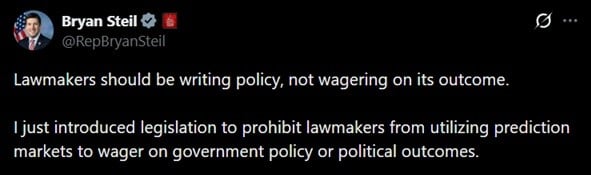
Rep. Bryan Steil (R-Wis.), chairman of the Committee on House Administration, unveiled the measure recently, framing it as a basic ethics guardrail. “It is inappropriate for members of Congress to trade on the outcomes of elections or public policy,” Steil said. The bill targets a fast-growing corner of the market where users can wager real money on whether a specific government policy, government action or political outcome will happen.
Under the legislation, House members, their spouses and their dependent children would be prohibited from placing such bets. Crucially, the ban is narrow, covering wagers on political and policy events (including anything that came to a lawmaker’s attention through their congressional service) while still permitting bets on unrelated events such as sports.
Violators stand to face a penalty of at least $2,000 or 10% of the trade’s value, whichever is higher, and would have to forfeit any net profits from the wager. Lawmakers would also be barred from using office funds or campaign money to pay those penalties, closing an obvious loophole.
The proposal arrives amidst notable political backing, with House Speaker Mike Johnson and President Donald Trump both supporting the measure. The move mirrors a step the Senate took earlier this year, when it adopted a rule barring senators and their staff from betting on prediction markets.
A Market Under Mounting Scrutiny
The bill comes into the fore as prediction markets have continued to face pressure on multiple fronts. Most recently, Bitcoin.com News reported that the House Oversight Committee, led by Rep. James Comer, launched a probe into Polymarket and Kalshi over insider-trading safeguards, with Comer calling the space a “wild west” where “there are no rules.”
The platforms have also drawn state-level challenges with Kalshi suing Minnesota to block the first US felony ban on prediction markets, arguing the contracts are federally regulated derivatives under exclusive Commodity Futures Trading Commission (CFTC) oversight.
In all of this, the stakes seem to be substantial, given the sector has grown explosively, with Polymarket and Kalshi together clearing a $25.7 billion month in April, turning what was once a niche corner of crypto into a mainstream venue for wagering on news.
Why Congress Is Worried
The concern animating Steil’s bill is straightforward, i.e. members of Congress routinely possess nonpublic information about whether legislation will pass, how agencies will act and when policy will shift. A liquid market that pays out on exactly those outcomes creates an obvious temptation to trade (making it the political-policy equivalent of insider trading in equities, which is already illegal for lawmakers under separate rules).
By carving out sports and other unrelated events, the bill tries to thread a needle, restricting the bets most prone to abuse without banning prediction markets outright. Whether that distinction holds up in practice and how it would be enforced across spouses/adult children will be interesting to watch.
Looking ahead, the Stop Lawmakers from Predicting Act faces an arduous journey of going through committee first and then a floor vote, even though the backing of the speaker and the president gives it unusual early momentum.