
A Warning From Inside
Trent Van Epps, who for years helped coordinate funding for Ethereum’s core developers, has cautioned that the people who maintain the network’s base layer could face a shortfall within three to nine months, citing recent spending cuts at the Ethereum Foundation (EF) and the winding down of its Client Incentive Program (CIP) as key triggers.
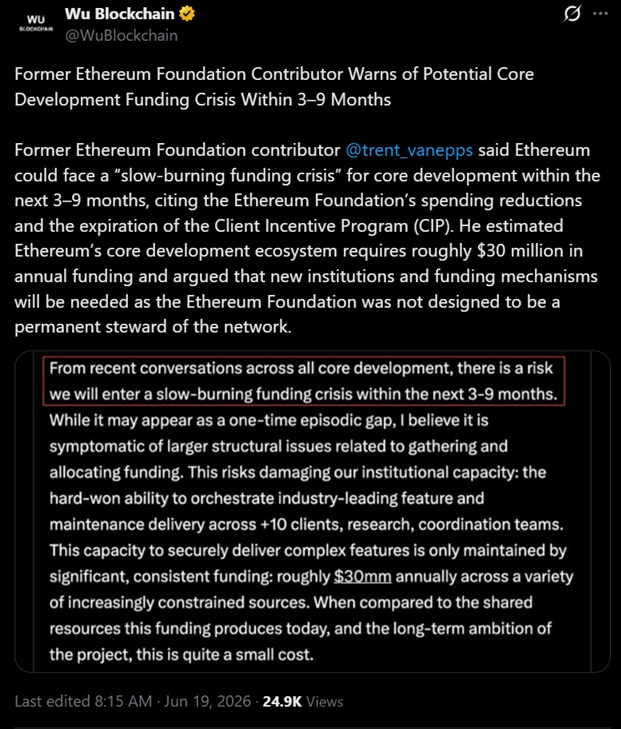
Van Epps highlighted the risk not as a sudden collapse but as a gradual erosion of the resources that pay the engineers and researchers responsible for upgrades, security, and network maintenance. He estimated that sustaining Ethereum’s core development ecosystem costs about $30 million a year, adding:
“The foundation was never meant to be the network’s permanent steward.”
For years, much of the incoming funding flowed through Protocol Guild, a collective Van Epps helped organize to channel money to the contributors who keep Ethereum running. The mechanism pools donations and token allocations and distributes them to core developers, but it has long depended on voluntary contributions rather than a predictable budget. Van Epps has described that reliance as a transitional solution rather than a permanent fix.
The concern comes at a time when one developer has gone so far as to propose a radical new organization (backed by as much as $1 billion) to put Ethereum’s core funding on a stable footing. The EF, meanwhile, has taken its own steps to shore up finances, converting 5,000 ETH to fund operations and staking tens of thousands of ether to generate recurring yield rather than selling into the market.
An Exodus of Talent
Van Epps’ warning follows a turbulent stretch for the foundation, given that eight senior researchers have left the EF this year, with five of those exits landing in May alone. The departures include high-profile figures such as co-executive director Tomasz Stańczak, alongside researchers and coordinators who had spent years on the project. Van Epps himself announced his exit on April 11, 2026, closing out a nearly five-year tenure.
Supporters of the foundation argue the restructuring is deliberate and an attempt to decentralize responsibility for Ethereum rather than concentrate it in a single body. The EF has continued to fund security work, including a $1 million audit subsidy program for builders, and has reiterated its 2026 protocol priorities around scaling and resilience. Whether that distributed model can replace the funding certainty the foundation once provided is the open question.
Why The Warning Matters
Core developers are the people who write, review, and maintain the software that secures hundreds of billions of dollars in value on Ethereum. Unlike a company with a fixed payroll, they have historically relied on a patchwork of grants, foundation budgets, and collective funding to stay in their roles. A sustained shortfall could push experienced contributors toward better-paid work elsewhere, slowing upgrades at a time when the network faces intense competition from rival chains.
The next few months will show whether Protocol Guild, the EF, and any new funding bodies can close the gap Van Epps describes before it bites. If they cannot, the people who maintain the second-largest blockchain by market value could be left competing for resources at the very moment Ethereum is racing to scale.