
In today’s crypto market, understanding how to properly value a project is essential for making informed investment decisions. As Layer 2 solutions like Arbitrum (ARB) and Optimism (OP) continue to grow in popularity, it’s important to break down how we can effectively evaluate their value using key metrics like fully diluted market cap (FDV), total value locked (TVL), and transactions per second (TPS).
In this blog, we’ll go over three stages of project valuation and dive deep into the current valuation of Layer 2 projects such as ARB and OP.
Stage 1: Valuing a Project by Token Price
When you’re new to crypto, it’s common to start by comparing the token prices of different projects. Many new investors fall into the trap of assuming that a higher token price means a project is more valuable.
However, this method is misleading because token prices don’t take into account important factors like market cap, supply, and circulation. For a more accurate valuation, we need to move beyond just looking at token prices.
Stage 2: Valuing by Market Cap
The next step many investors take is to compare projects by their market cap. This approach is an improvement because it considers the total value of all tokens in circulation. However, while market cap is useful, it’s not enough to give a full picture of whether a project is overvalued or undervalued.
Let’s take it one step further.
Stage 3: Fully Diluted Market Cap (FDV)
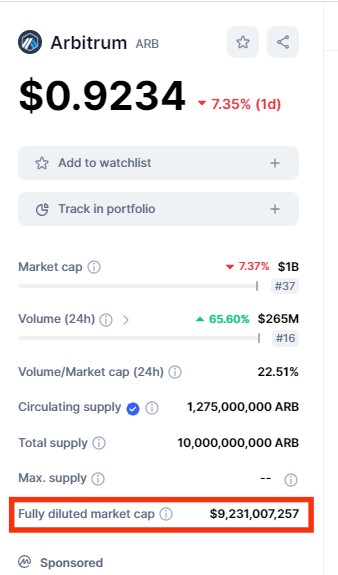
The most accurate way to value a crypto project, in my opinion, is by looking at its Fully Diluted Market Cap (FDV). FDV represents the total value of a project if all its tokens were to be released into circulation. This is a critical metric, especially for projects that haven’t fully unlocked their token supply.
FDV Formula:
FDV=TokenPrice×TotalSupply(MaxSupply)
You can check FDV on sites like CoinMarketCap or CoinGecko, but to be more accurate, verify the total supply directly through the project’s contract.
Comparing FDV of Arbitrum (ARB) and Optimism (OP)
Let’s take a look at two leading Layer 2 solutions: Arbitrum (ARB) and Optimism (OP).
- ARB FDV: $9.3B
- OP FDV: $4.6B
This means that Arbitrum is currently valued at 2x more than Optimism. Is this justified? Let’s look at more metrics.
TVL (Total Value Locked) & TPS (Transactions Per Second)
To understand whether ARB’s higher FDV is justified, we need to compare the fundamental metrics of both projects.
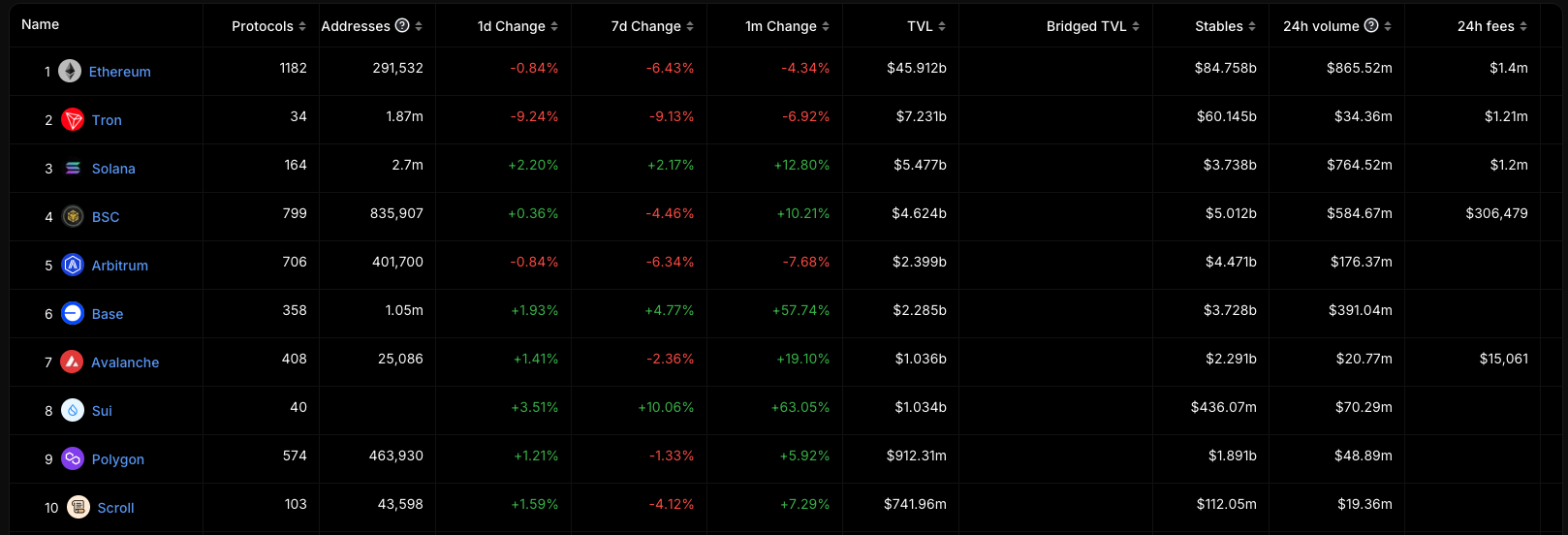
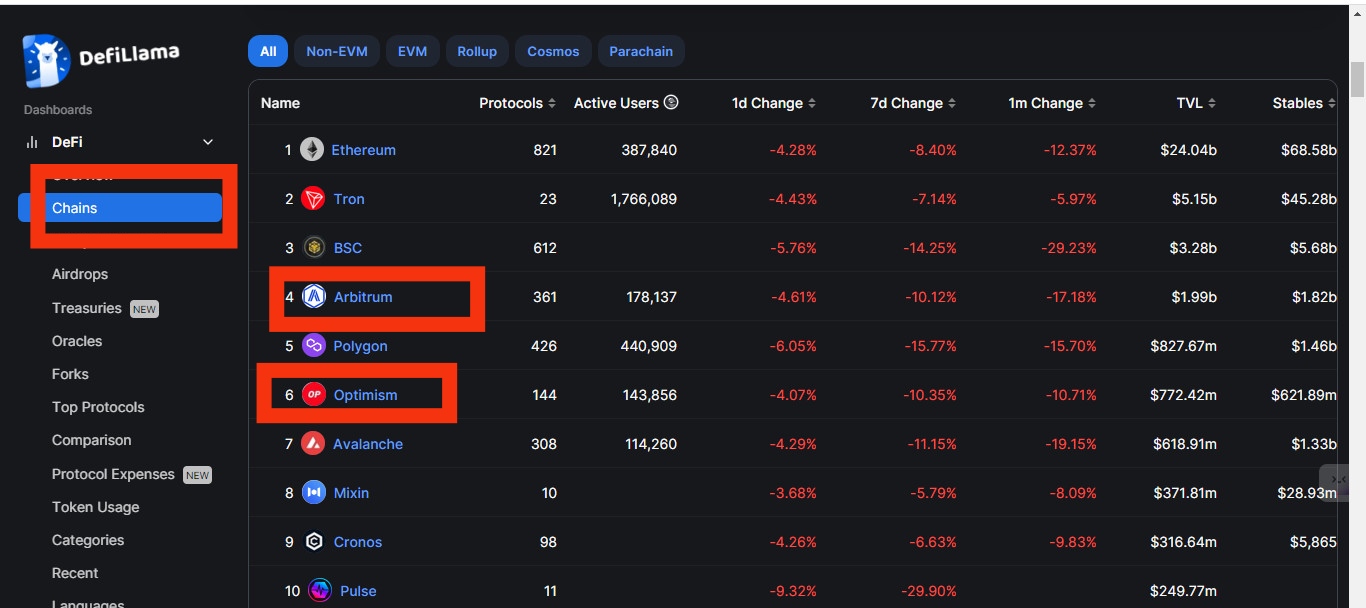
Using DeFiLlama for TVL comparisons:
- ARB TVL: $1.99B
- OP TVL: $772M
Additionally, Arbitrum hosts 361 protocols, while Optimism only has 141. In terms of active users, ARB has 178,000 while OP has 143,000.
Based on these metrics, Arbitrum leads Optimism in terms of network activity and user engagement, which justifies a higher valuation—though double the FDV is something to question.
Are ARB and OP Overvalued?
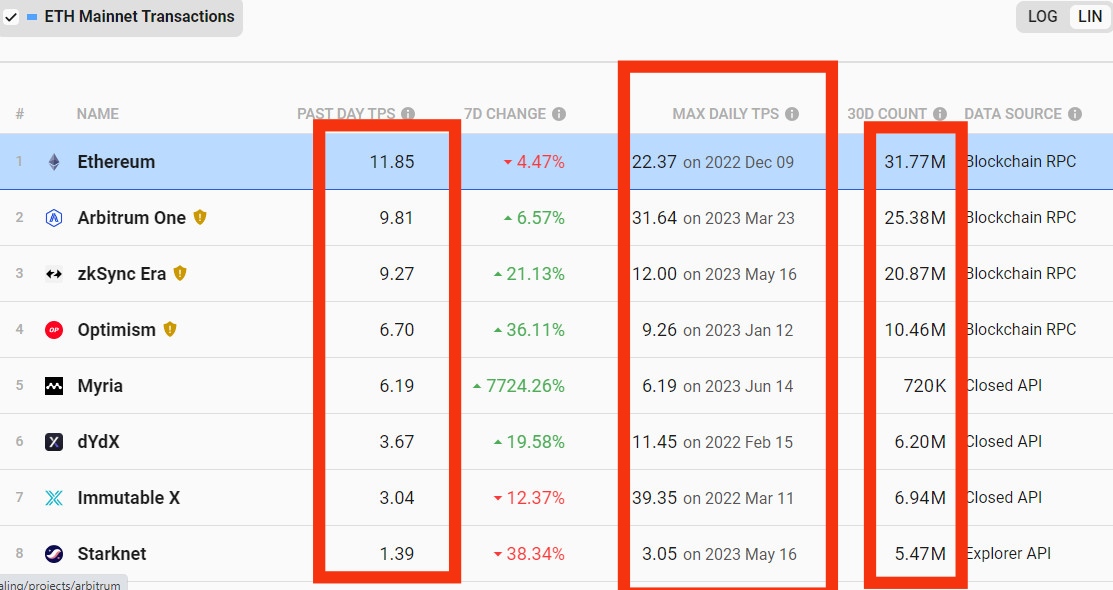
Looking beyond TVL and protocols, let’s consider transactions per second (TPS). One of the main advantages of Layer 2s is their faster transaction speeds compared to Ethereum. However, in reality, Layer 2 TPS numbers are not as impressive as you might think:
- Arbitrum TPS: 31.64
- Ethereum TPS: 22.37
While Arbitrum slightly surpasses Ethereum’s TPS, it still lags behind other Layer 1s, such as Solana, which boasts a TPS of 4,200.
When you compare the FDV of ARB at $9.3B to Solana’s FDV of $8B, you can see that Arbitrum is potentially overvalued. Solana has a fully developed ecosystem with a higher TPS, a successful DeFi ecosystem, and a strong community, yet Arbitrum’s FDV exceeds it.
Conclusion: Is Arbitrum (ARB) Overvalued?
Given the comparison metrics, Arbitrum seems to be overvalued at its current FDV of $9.3B. In contrast, Optimism is more reasonably valued at $4.6B, though it also has room for improvement.
In my opinion, a fair valuation for Arbitrum would be around $6B, while Optimism would be better valued at $3B. The current levels of FOMO and market speculation are inflating their prices, and it may take some negative news (or FUD) to bring them back down to their true value.