Home » New Rules for Crypto in Brazil: Central Bank Demands Strict Independent Audits for VASPs

New Rules for Crypto in Brazil: Central Bank Demands Strict Independent Audits for VASPs

New Rules for Crypto in Brazil: Central Bank Demands Strict Independent Audits for VASPs 1

Central Bank Of Brazil Moves to Add Audit Requirement for VASPs

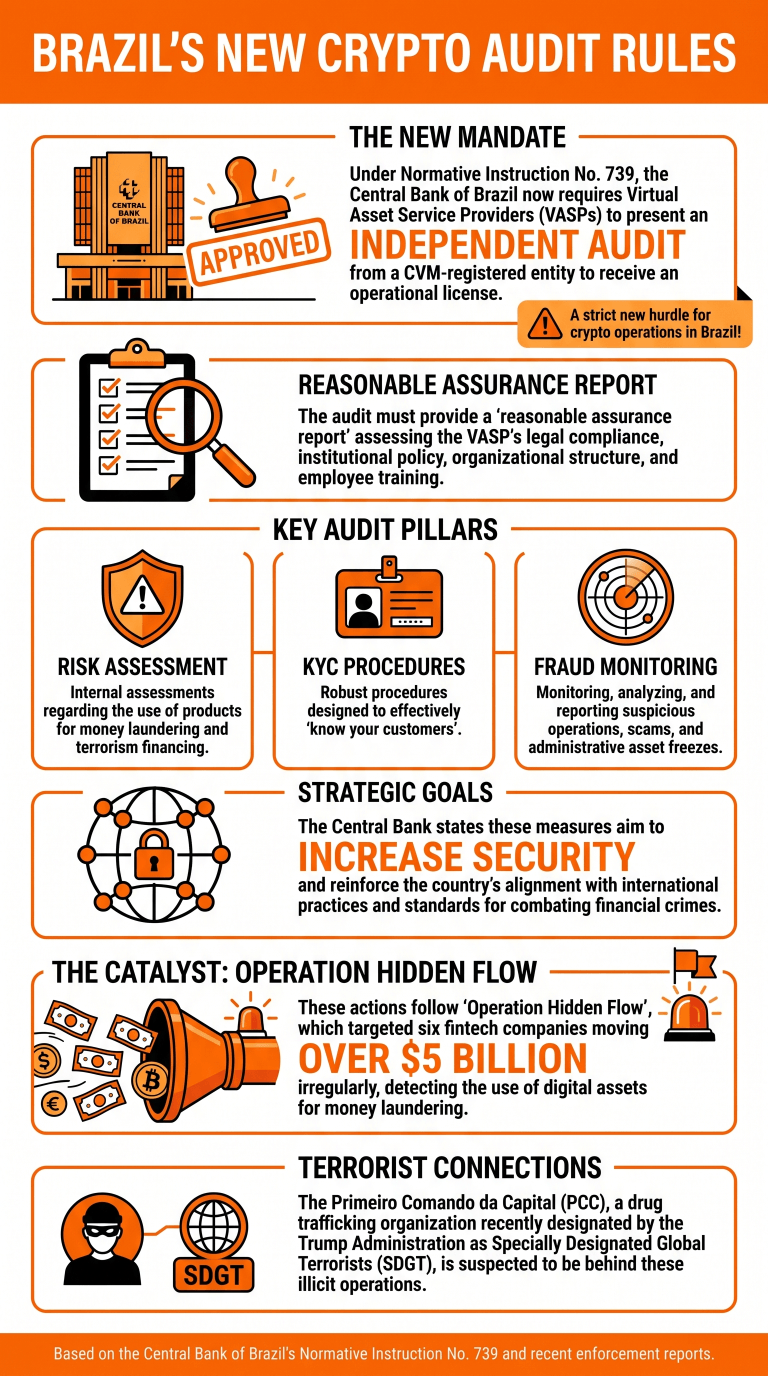
The Central Bank of Brazil has introduced yet another requirement to approve the operation of virtual asset service providers (VASPs) in the country.

Under Normative Instruction No. 739, issued on Friday, the bank now requires VASPs to present an independent audit from an entity registered with the Brazilian Securities and Exchange Commission (CVM) to issue operational licenses.
New Rules for Crypto in Brazil: Central Bank Demands Strict Independent Audits for VASPs 2

The audits, referred to as “reasonable assurance reports,” must contain data assessing the VASP’s legal compliance in different aspects, including institutional policy, organizational structure, and employee training; internal risk assessment regarding the use of the company’s products and services in the commission of money laundering and terrorism financing crimes; and procedures designed to get to know your customers.

Furthermore, this report should also assess the readiness of the audited VASP on monitoring, selection, analysis, and reporting of operations and situations suspected of money laundering and the financing of terrorism and weapons of mass destruction; monitoring and analysis of evidence of the occurrence or attempted occurrence of fraud and scams; and administrative asset freezes.

The bank stated that these measures aim to “increase the security of decisions in authorization processes, while reinforcing the country’s alignment with international practices and standards for combating these crimes.” It also reinforced that “verification by independent audit contributes to greater transparency and reliability in the controls adopted by companies in the sector.”

The actions come after Operation Hidden Flow, a high-stakes operation that targeted six fintech companies moving over $5 billion irregularly, detected the use of digital assets for money laundering.

The Primeiro Comando da Capital, a drug trafficking organization recently designated by the Trump Administration as Specially Designated Global Terrorists (SDGT), is suspected to be behind these operations.

Related Articles

Alleged 'Pig Butchering' Prince Group Kingpin Hu Shi Arrested in Japan 1

Alleged ‘Pig Butchering’ Prince Group Kingpin Hu Shi Arrested in Japan

Cyprus National Tied To Prince Group Arrested in Japan Hu Shi, believed to be one of the managers of Prince

Bank of England Drops Stablecoin User Caps and Sets $53 Billion Issuance Limit 1

Bank of England Drops Stablecoin User Caps and Sets $53 Billion Issuance Limit

Bank of England Revises Stablecoin Rules to Support Growth The Bank of England has moved to make its systemic stablecoin

1,200 Tech Companies Push Senate to Pass CLARITY Act Quickly as US Crypto Rules Face Global Pressure 1

1,200 Tech Companies Push Senate to Pass CLARITY Act Quickly as US Crypto Rules Face Global Pressure

CTA Calls for Swift Senate Action on CLARITY Act The Consumer Technology Association (CTA) urged Senate leadership to advance the

Ireland Targets Crypto Assets in New Strategy to Disrupt Illicit Cash Flows 1

Ireland Targets Crypto Assets in New Strategy to Disrupt Illicit Cash Flows

Targeting Digital Assets and Crypto Loopholes Ireland announced a sweeping crackdown on financial crime on June 18, unveiling a national

VARA urges Dubai crypto companies to monitor FATF blacklists, enhancing risk management. 1

VARA urges Dubai crypto companies to monitor FATF blacklists, enhancing risk management.

New Framework Demands Quantitative Data The Dubai Virtual Assets Regulatory Authority (VARA) has published new guidance aimed at tightening financial

Bank of Ghana Orders Banks to Halt Crypto Dollar Wallets as Enforcement Risks Rise 1

Bank of Ghana Orders Banks to Halt Crypto Dollar Wallets as Enforcement Risks Rise

Breach of National Financial Laws The Bank of Ghana has issued a directive ordering regulated financial institutions to immediately halt