A Four-Year Prohibition
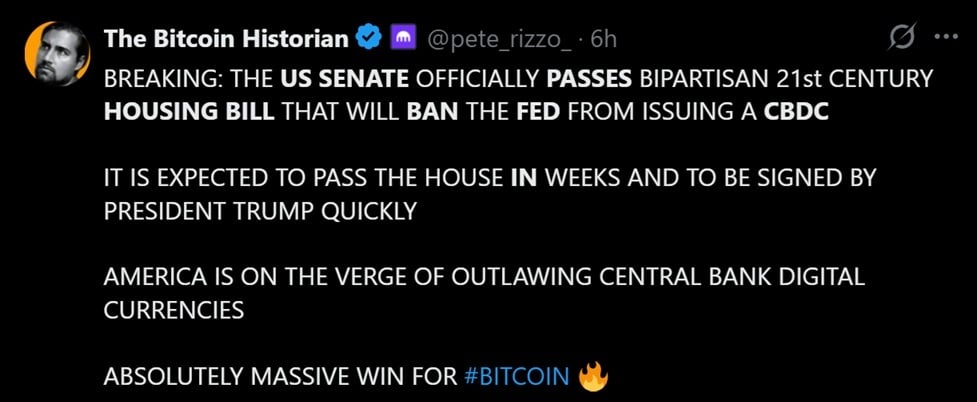
Senators voted 85-5 on June 22 to advance the housing affordability bill, which carries a provision prohibiting the central bank from creating a digital dollar through the end of 2030. The CBDC language was folded into a much larger package aimed at lowering housing costs and curbing Wall Street purchases of single-family homes, giving the digital-currency ban a rare path to becoming law on a bipartisan vehicle. The text was explicit, noting:
“The Board of Governors of the Federal Reserve System or a Federal reserve bank may not issue or create a central bank digital currency or any digital asset that is substantially similar to a central bank digital currency directly or indirectly through a financial institution or other intermediary,” according to the bill.
The “directly or indirectly” wording is the heart of the provision as it is designed to stop the Fed from launching a digital dollar through commercial banks or payment firms, a workaround that CBDC critics had warned could sidestep a narrower ban. The prohibition is temporary, however, expiring at the end of 2030 unless Congress renews it.
Opponents of a U.S. digital dollar have framed the technology as a surveillance risk. Federal Reserve Chair Kevin Warsh called a CBDC a “bad policy choice” during his nomination hearing, aligning the central bank’s new leadership with the bill’s intent. President Trump has gone further, warning in an executive order that a digital dollar could “threaten the stability of the financial system, individual privacy, and the sovereignty of the United States.”
From State Bans to Federal Law
The Senate vote caps a multi-year push that began at the state level. For instance, South Carolina Governor Henry McMaster recently signed an anti- CBDC law protecting self-custody rights, while North Carolina’s legislature overrode a gubernatorial veto to reject a federal digital currency (late 2024).
Those efforts, however, stalled as standalone measures, but by attaching the ban to a popular housing bill, supporters found a vehicle with enough bipartisan momentum to clear the 60-vote threshold and then some, with the final tally reaching 85-5.
The provision also builds on executive action, given that earlier this year, Trump signed an order barring federal agencies from developing or promoting a CBDC, reversing earlier government work on a digital dollar. The new bill would convert that executive directive into statute, making it harder for a future administration to revive the project before 2030.
The Next Developments to Watch
Attention now shifts to the House, where leaders were reportedly weighing an accelerated process to pass the bill as soon as Tuesday. If the House approves the package without changes, it would head to Trump’s desk, and his signature would make the CBDC ban law.
The crypto industry has watched the bill closely since a federal ban on a government-issued digital dollar removes a competitive threat to private stablecoins and clears the field for dollar-pegged tokens issued by the private sector. For bitcoin advocates, the measure is also symbolic, codifying a distinction between decentralized money and a state-controlled digital currency.
Should the bill pass intact, the United States would join a small group of jurisdictions to legally prohibit a central bank digital currency, even as dozens of other countries continue to pilot their own.