A $50 Billion Target
The decentralized oracle network, software that delivers real-world prices onto blockchains, unveiled the new proprietary indices earlier in the week. The lineup spans U.S. equity baskets, gold and silver, and WTI and Brent crude oil, alongside Coinbase-specific equity index futures built with index provider Marketvector.

Early adopters include Coinbase, Kraken, Dydx, and Nado, Pyth said, with the products designed to give continuous reference prices for assets that historically traded only during set market hours. Mike Cahill, chief executive of Douro Labs, a key contributor to Pyth, said:
“Pyth Indices mark an inflection point in access to 24/7 markets, where ‘market close’ no longer means the end of trading.”
The launch is the latest step in what analysts have called Pyth’s $50 billion institutional pivot, a strategy to move beyond supplying free price feeds to crypto apps and start selling data to banks, brokers, and trading firms (a business long dominated by terminal providers such as Bloomberg and Refinitiv).
Challenging the Terminal
Pyth’s pitch is that market data should be published onchain, openly and in real time, rather than locked behind expensive proprietary terminals. To make that case, the network has begun recruiting the institutions that generate the data themselves. In this regard, six financial institutions (including Euronext, Fidelity, and Tradeweb) have already started publishing market data on the blockchain via Pyth, directly challenging Bloomberg’s grip on the sector.
In a separate expansion, Pyth announced seven new institutional data publishers as it launched the Pyth Data Marketplace, a distribution engine that lets institutions publish and monetize unique datasets across blockchains and applications.
The network has also widened its coverage into areas that touch policy and macro trading, adding price feeds for major U.S. exchange-traded funds (ETFs), the United Kingdom’s top 100 public companies, Hong Kong and Chinese equities, and U.S. government economic data.
The institutional voices behind the indices echo the pitch. Boris Ilyevsky, head of derivatives at Coinbase, one of the venues adopting the new products, said “institutional-grade, 24/7 markets are becoming the standard” while John Palmer, Kraken’s global head of derivatives, said the indices “give us a continuous benchmark for assets where the underlying market doesn’t trade round the clock.”
Revenue and the PYTH Token
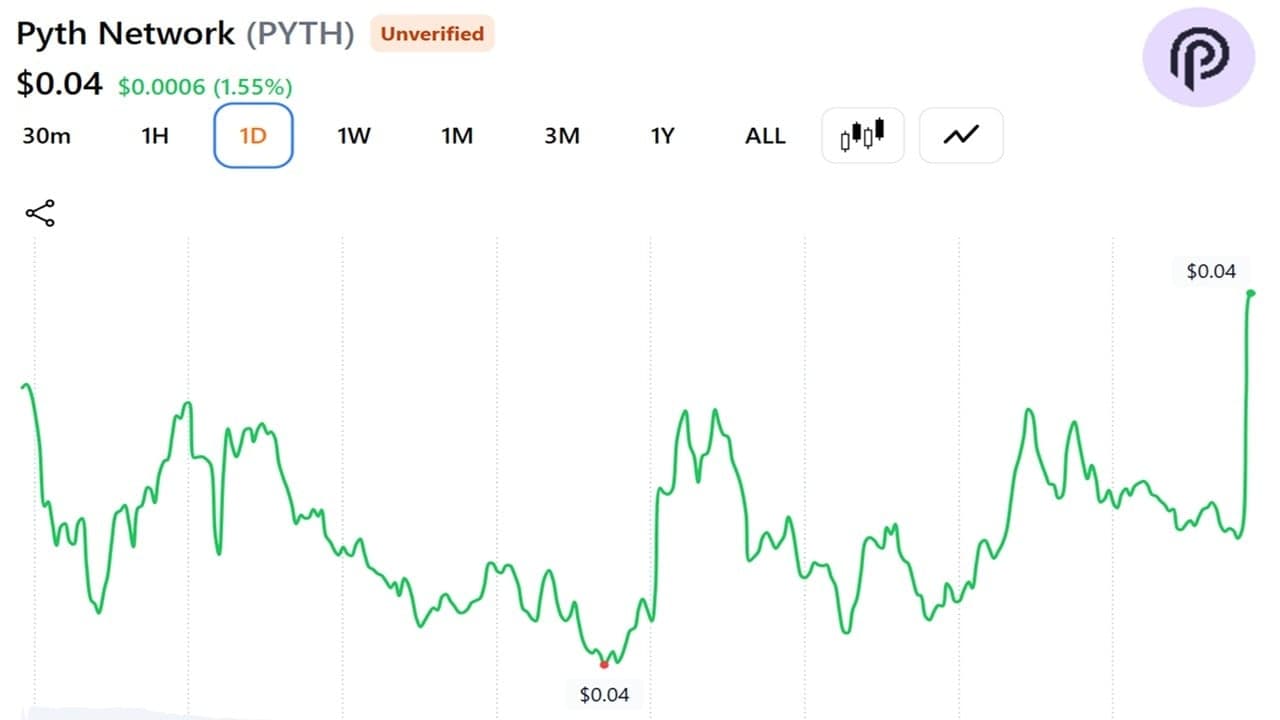
For PYTH, the network’s native token, the institutional push is the central investment thesis. To elaborate, Pyth has launched a subscription product, Pyth Pro, that it says quickly surpassed $1 million in annual recurring revenue, and a version aimed at autonomous AI agents that delivers more than 3,000 institutional price feeds through a single integration.
The company has signaled that revenue from offchain, institutional data is where it expects future monetization to come from. In any case, the direction of travel is clear, i.e. crypto infrastructure firms are increasingly aiming at traditional finance rather than just serving onchain apps, and Pyth’s expansion mirrors moves by exchanges like Coinbase to bring round-the-clock, real-world-asset markets into the regulated mainstream.
The next test for Pyth is conversion and whether the institutions now publishing data and adopting its indices become paying customers at scale.