An IPO sells shares in a company. An ICO sells tokens from a crypto project. That line captures the surface difference, but the part that matters to anyone putting money in lives one layer down: in what you actually receive, who regulates the sale, and what recourse you have if the offering fails or turns out to be a fraud.
In an initial public offering, buyers usually get equity: a real ownership stake in a business, backed by a mature disclosure system. In an initial coin offering, buyers get a digital token, and what that token does, or is worth, depends entirely on the project that issued it. From a distance the two rhyme, since both raise money from the public. The fine print is where they part ways.
This guide compares them across the dimensions that decide outcomes: shares versus tokens, ownership rights, regulation, who can take part, and risk.
Key Takeaways
- An IPO sells company shares to the public, while an ICO sells digital tokens issued by a crypto project.
- IPO investors usually receive equity ownership in a business, while ICO buyers receive tokens whose rights depend on the project’s design, legal terms, and smart contract.
- IPOs operate through a mature securities framework with prospectuses, audited financials, SEC filings, and ongoing disclosure obligations.
- ICOs vary much more widely: some may be regulated securities offerings, while others may involve utility tokens, governance tokens, or tokens with few enforceable rights.
- The biggest practical difference is recourse: IPO buyers generally have clearer shareholder rights and legal protections, while ICO buyers may have limited remedies if the project fails or turns out to be fraudulent.
- Shares and tokens are not interchangeable. A share is usually a legal claim on a company; a token is a blockchain-based asset that may or may not provide ownership, utility, governance, or economic rights.
- ICO risk is usually broader than IPO risk because it can include weak disclosure, fraud, token unlocks, regulatory uncertainty, smart-contract bugs, wallet mistakes, and poor liquidity.
- Before evaluating either an IPO or ICO, the most important question is simple: what exactly are you buying, what rights come with it, and who is legally accountable if things go wrong?
IPO vs ICO: Quick Comparison
An IPO, or initial public offering, is when a private company sells shares to the public for the first time, usually through a regulated, exchange-listed process. An ICO, or initial coin offering, is when a crypto project sells digital tokens to raise funds. IPO investors generally receive shares that represent ownership in the company. ICO buyers receive tokens whose rights depend on how the project designed and sold them.
FeatureIPOICOFull nameInitial public offeringInitial coin offeringWhat is soldShares of stockDigital tokensBuyer receivesEquity ownership in the companyTokens with project-specific rightsMain purposeRaise capital and go publicFund a crypto project or networkRegulationRegistered securities offeringVaries; may be a securities offeringDisclosureProspectus and SEC filingsWhitepaper, website, token terms; sometimes filingsWhere it tradesStock exchangesCrypto exchanges, launchpads, wallets, or nowhereTypical buyersInstitutional and retail investorsCrypto users, retail buyers, early backersMain riskValuation, business performance, lockupsFraud, weak disclosure, token failure, regulatory riskFeatureFull nameIPOInitial public offeringICOInitial coin offeringFeatureWhat is soldIPOShares of stockICODigital tokensFeatureBuyer receivesIPOEquity ownership in the companyICOTokens with project-specific rightsFeatureMain purposeIPORaise capital and go publicICOFund a crypto project or networkFeatureRegulationIPORegistered securities offeringICOVaries; may be a securities offeringFeatureDisclosureIPOProspectus and SEC filingsICOWhitepaper, website, token terms; sometimes filingsFeatureWhere it tradesIPOStock exchangesICOCrypto exchanges, launchpads, wallets, or nowhereFeatureTypical buyersIPOInstitutional and retail investorsICOCrypto users, retail buyers, early backersFeatureMain riskIPOValuation, business performance, lockupsICOFraud, weak disclosure, token failure, regulatory risk
What Is an IPO?
An initial public offering is the process by which a private company first sells shares of its stock to public investors. Those shares then typically list and trade on an exchange such as the New York Stock Exchange or Nasdaq, giving the company a public market for its equity and giving early shareholders a way to sell.
The U.S. Securities and Exchange Commission describes an IPO as the first time a company offers its shares of capital stock to the general public in a registered offering. Under federal securities law, a company cannot lawfully sell those shares unless the offering is registered with the SEC or qualifies for an exemption.
Registration runs through a filing, usually a Form S-1, and the centerpiece of that filing is the prospectus, the document that lays out the business, the terms of the offering, the financials, and the risks an investor should weigh.
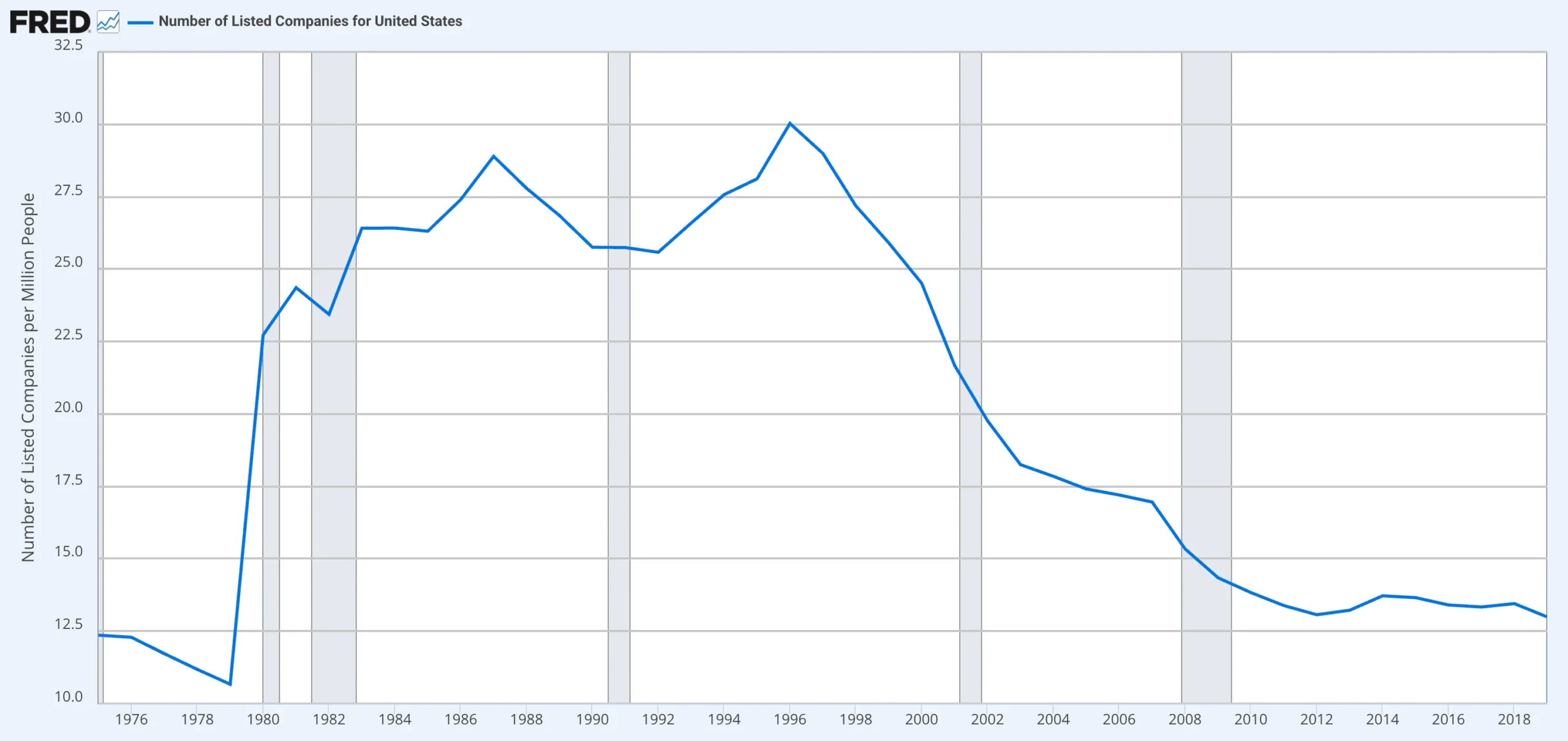
It is worth pausing on a long-running backdrop here: even as the IPO machinery has matured, the population of public companies has been thinning out. The chart below tracks the number of U.S.-listed companies per million people. It climbed through the 1980s and 1990s, peaked near 30 around 1996, and has roughly halved to about 13 since.
How an IPO works
The path to a public listing is deliberate and disclosure-heavy:
- The company decides to go public and selects investment banks to act as underwriters.
- It prepares a registration statement and prospectus disclosing its finances, business model, and risk factors.
- Regulators review the filing, and the company answers their comments.
- Management markets the deal to investors, often through a “roadshow.”
- The underwriters and company set an offering price based on demand.
- Shares are sold to initial investors, then begin trading publicly on the exchange.
The design goal is simple: investors should be able to read standardized, audited information before they buy. After listing, the company carries ongoing obligations, including quarterly and annual financial reports (Forms 10-Q and 10-K). None of this removes risk (plenty of IPOs trade below their offering price, sometimes for years) but it sets a baseline of transparency that buyers can rely on.
What investors receive in an IPO
A share usually represents a slice of ownership in the company. Depending on the share class, that can carry voting rights on certain corporate matters, economic exposure that rises and falls with the stock, and the possibility of dividends if the company declares them. It also comes with public-market liquidity (shares can generally be sold after listing, subject to any lockup periods) and the right to ongoing company disclosures.
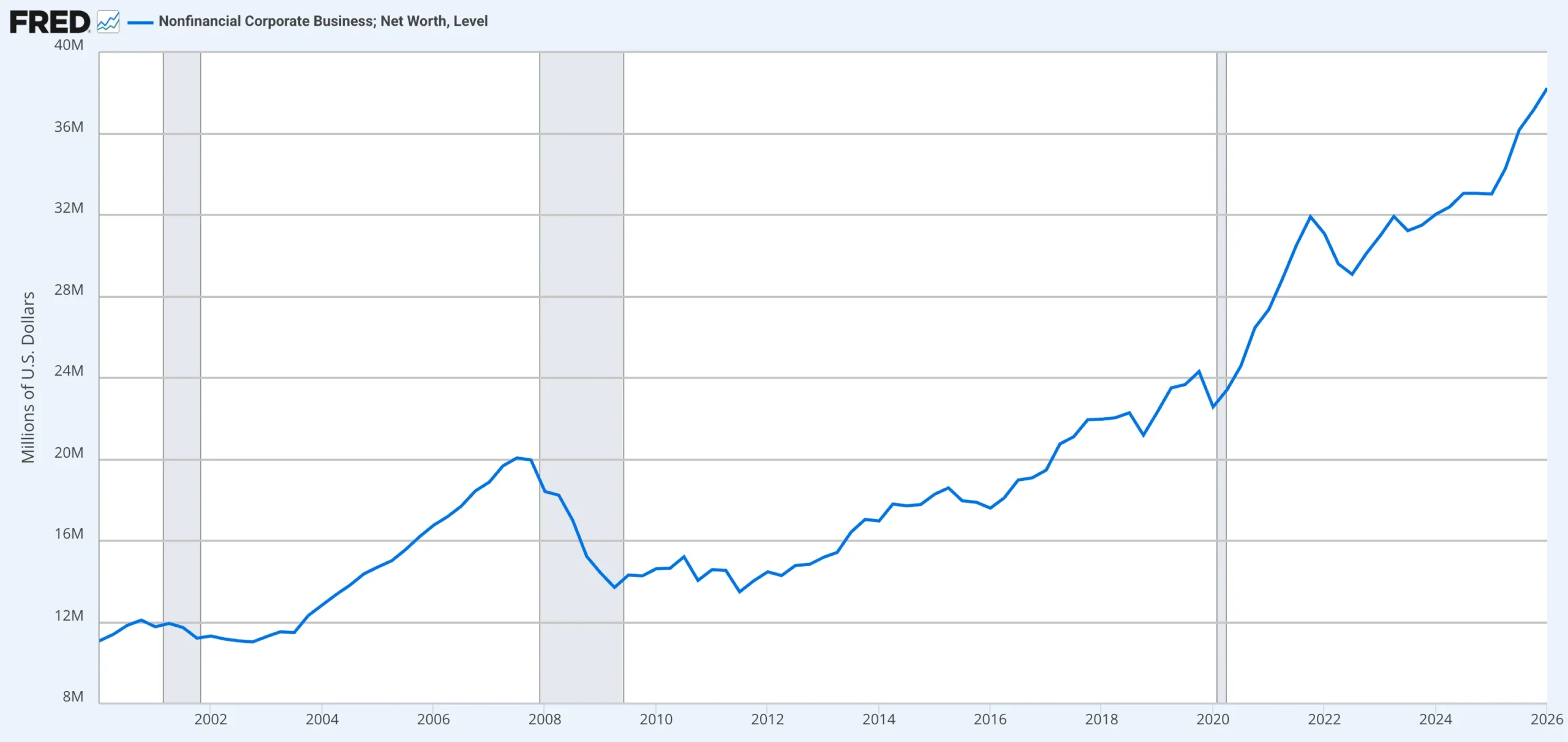
What makes that ownership stake meaningful is the real value sitting behind it. The chart below tracks the aggregate net worth of U.S. nonfinancial corporations, which has climbed from around $11 trillion in 2000 to roughly $38 trillion today, dipping only during the 2008 and 2020 recessions. That growing pool of corporate value is precisely what a share, unlike a bare token, gives you a legal claim on.
Not every share carries the same rights. Many public companies use dual-class structures that concentrate voting power with founders, and lockups can restrict when insiders sell. The prospectus is where those details are spelled out, which is the strongest argument for actually reading it, a discipline The Big Short immortalized by showing how much trouble hides in documents nobody bothers to open.
What Is an ICO?
An initial coin offering is a crypto fundraising method in which a project sells digital tokens to raise capital. A token might grant access to a product, a vote in a protocol’s governance, a means of payment inside a network, or rewards. Or, in some structures, something closer to an investment stake. The rights attached to a token come from the project that minted it, not from a standard rulebook.
The SEC’s investor bulletin describes ICOs, also called token sales, as offerings in which virtual coins or tokens are created and distributed using blockchain or distributed ledger technology to raise capital. The same bulletin warns that ICOs can be used improperly to lure investors with promises of outsized returns, and that, depending on the facts of each offering, the tokens sold may be securities subject to federal securities law.
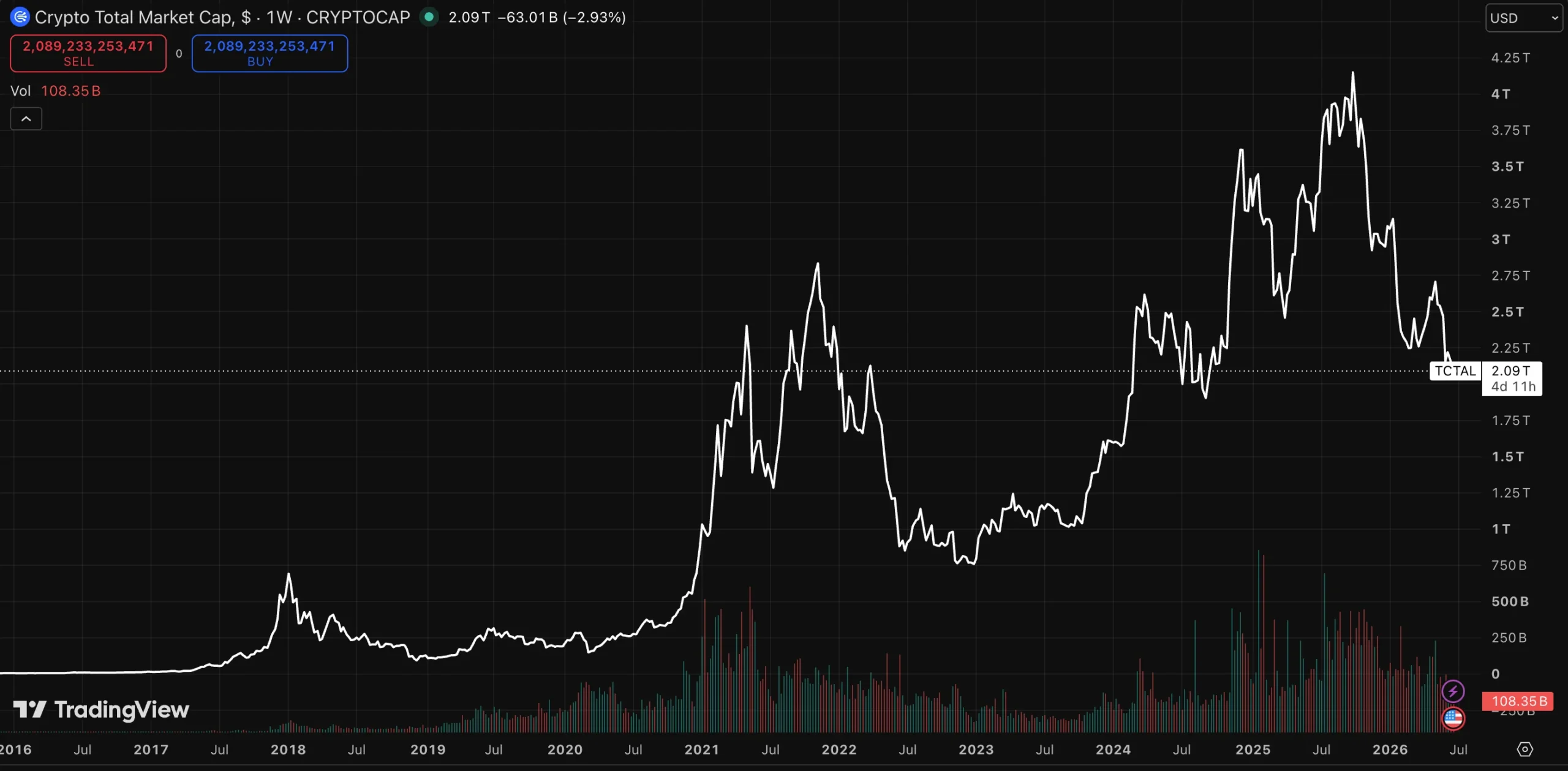
To grasp why this method drew so much money and attention, it helps to see the scale of the market it helped create. The chart below plots total crypto market capitalization, which grew from almost nothing in 2016 to a peak above $4 trillion in 2025 before settling near $2 trillion. That is the permissionless funding wave token sales rode, and which the formats that succeeded the ICO continue to ride.
How an ICO works
A typical token sale follows a loose pattern:
- A team proposes a token or network and publishes a whitepaper or website describing it.
- It defines the token supply, sale price, and how tokens will be allocated.
- Buyers send crypto or fiat to take part, depending on the sale’s structure.
- Tokens are distributed to buyers’ wallets, often through a smart contract.
- The project uses the proceeds to build or operate.
- Tokens may later trade on exchanges or be used inside the ecosystem.
ICOs vary enormously, and the 2017–2018 boom is the proof. Some were open public sales, some private rounds limited to a few backers, some carried securities-like rights, and some were pure theater. At the honest end sat the Useless Ethereum Token, which launched in 2017 billing itself as “100% honest,” told buyers outright that the tokens did nothing, and joked that the founder would spend the proceeds on a big-screen TV. Then, raised tens of thousands of dollars anyway.
At the criminal end sat Centra Tech, which raised roughly $25 million on the strength of endorsements from boxer Floyd Mayweather and producer DJ Khaled; the SEC charged its founders with fraud, both celebrities settled for promoting it without disclosing they were paid, and the founders ended up convicted. Two sales, near-identical landing pages, completely different realities underneath, which is exactly the problem with judging a token by its website.
What buyers receive in an ICO
The token a buyer ends up holding might be a utility token that unlocks a product or service, a governance token that confers voting power over a protocol, a payment token meant for transfers, a reward token used for incentives, or a token with investment-like features that may be treated as a security. In some cases it confers no enforceable rights at all beyond being tradable.
Buying an ICO token does not automatically give you ownership of the company or protocol behind it. A token’s rights flow from the project’s terms, its smart contract, its legal structure, and the law that applies, the single most important thing to verify before participating.
IPO vs ICO: Key Differences
Putting the mechanics side by side is the fastest way to separate the two.
CategoryIPOICOAsset soldSharesTokensOwnershipUsually equity ownershipUsually not equity, unless structured that wayLegal frameworkRegistered public securities offeringVaries; may be a securities offeringDisclosureStandardized prospectus and filingsWhitepaper and token docs; quality varies widelyInvestor rightsEstablished shareholder rightsToken-specific rights onlyWho raises fundsA private company going publicA crypto project, protocol, company, or foundationIntermediariesUnderwriters, auditors, lawyers, exchangesSmart contracts, launchpads, exchanges, walletsBuyer accessOften allocated through brokers and institutionsOften broader, but varies by jurisdictionTrading venueStock exchangeCrypto exchange, DEX, or no active marketMain risksMarket, valuation, business, lockupFraud, utility, regulation, liquidity, technicalCategoryAsset soldIPOSharesICOTokensCategoryOwnershipIPOUsually equity ownershipICOUsually not equity, unless structured that wayCategoryLegal frameworkIPORegistered public securities offeringICOVaries; may be a securities offeringCategoryDisclosureIPOStandardized prospectus and filingsICOWhitepaper and token docs; quality varies widelyCategoryInvestor rightsIPOEstablished shareholder rightsICOToken-specific rights onlyCategoryWho raises fundsIPOA private company going publicICOA crypto project, protocol, company, or foundationCategoryIntermediariesIPOUnderwriters, auditors, lawyers, exchangesICOSmart contracts, launchpads, exchanges, walletsCategoryBuyer accessIPOOften allocated through brokers and institutionsICOOften broader, but varies by jurisdictionCategoryTrading venueIPOStock exchangeICOCrypto exchange, DEX, or no active marketCategoryMain risksIPOMarket, valuation, business, lockupICOFraud, utility, regulation, liquidity, technical
Three of these carry most of the weight.
Ownership: IPO shares represent a stake in a company; ICO tokens generally do not. A token can be designed to do many things, but issuing one hands you no piece of the issuer.
Regulation: An IPO is a registered securities offering with a defined compliance process. An ICO sits across a wider and more uncertain legal range, covered in detail below.
Disclosure: IPO investors read an audited prospectus and ongoing reports. ICO buyers often rely on a whitepaper and a website, with no guarantee the claims are complete, audited, or accurate.
The gap is wider than most beginners expect:
Due-diligence factorSEC Form S-1 prospectus (IPO)Typical crypto whitepaper (ICO)Financial statementsMandatory; audited by an independent accounting firmRarely included; usually no formal auditLegal liabilityManagement and underwriters can be held liable for false statements”As-is” disclaimers; little personal liability for the authorsUse of proceedsDetailed, line-item budgetOften a vague pie chart (“40% ecosystem, 20% marketing”)Risk disclosuresExhaustive, standardized risk factors running to dozens of pagesFrequently thin, sometimes a generic smart-contract warningDue-diligence factorFinancial statementsSEC Form S-1 prospectus (IPO)Mandatory; audited by an independent accounting firmTypical crypto whitepaper (ICO)Rarely included; usually no formal auditDue-diligence factorLegal liabilitySEC Form S-1 prospectus (IPO)Management and underwriters can be held liable for false statementsTypical crypto whitepaper (ICO)”As-is” disclaimers; little personal liability for the authorsDue-diligence factorUse of proceedsSEC Form S-1 prospectus (IPO)Detailed, line-item budgetTypical crypto whitepaper (ICO)Often a vague pie chart (“40% ecosystem, 20% marketing”)Due-diligence factorRisk disclosuresSEC Form S-1 prospectus (IPO)Exhaustive, standardized risk factors running to dozens of pagesTypical crypto whitepaper (ICO)Frequently thin, sometimes a generic smart-contract warning
Access: Allocations in a “hot” IPO are controlled by underwriters and frequently go to institutions, which can make it hard for individuals to buy at the offering price. Token sales are often open to a wider pool, though jurisdiction and accreditation rules can restrict who participates.
Risk: Both can lose value. ICOs layer additional technical and legal risks on top. A smart-contract bug, a lost private key, a project that never ships, or an offering that runs afoul of securities rules.
Shares vs Tokens
The stock-versus-token distinction is where most confusion starts, so it is worth isolating. A share is a legal claim on a company, recorded by a broker or transfer agent. A token is a digital asset recorded on a blockchain, which can be self-custodied in a wallet. Both are “things you buy and might sell later,” and that surface similarity hides how unlike they are.
QuestionShare / stockTokenIs it ownership?Usually yesNot automaticallyDoes it trade on-chain?Usually noUsually yesDoes it give voting rights?SometimesDepends on the token’s designDoes it pay dividends?SometimesUsually no, unless structured toRecorded by broker / transfer agent?Usually yesUsually wallet- and blockchain-basedCan it be self-custodied?Usually noOften yesCan the keys be lost?Not relevantYes, if self-custodiedQuestionIs it ownership?Share / stockUsually yesTokenNot automaticallyQuestionDoes it trade on-chain?Share / stockUsually noTokenUsually yesQuestionDoes it give voting rights?Share / stockSometimesTokenDepends on the token’s designQuestionDoes it pay dividends?Share / stockSometimesTokenUsually no, unless structured toQuestionRecorded by broker / transfer agent?Share / stockUsually yesTokenUsually wallet- and blockchain-basedQuestionCan it be self-custodied?Share / stockUsually noTokenOften yesQuestionCan the keys be lost?Share / stockNot relevantTokenYes, if self-custodied
Self-custody cuts both ways. It gives token holders direct control without an intermediary, and it puts the full burden of security on them. A lost or stolen private key can mean a permanent loss with no help desk to call.
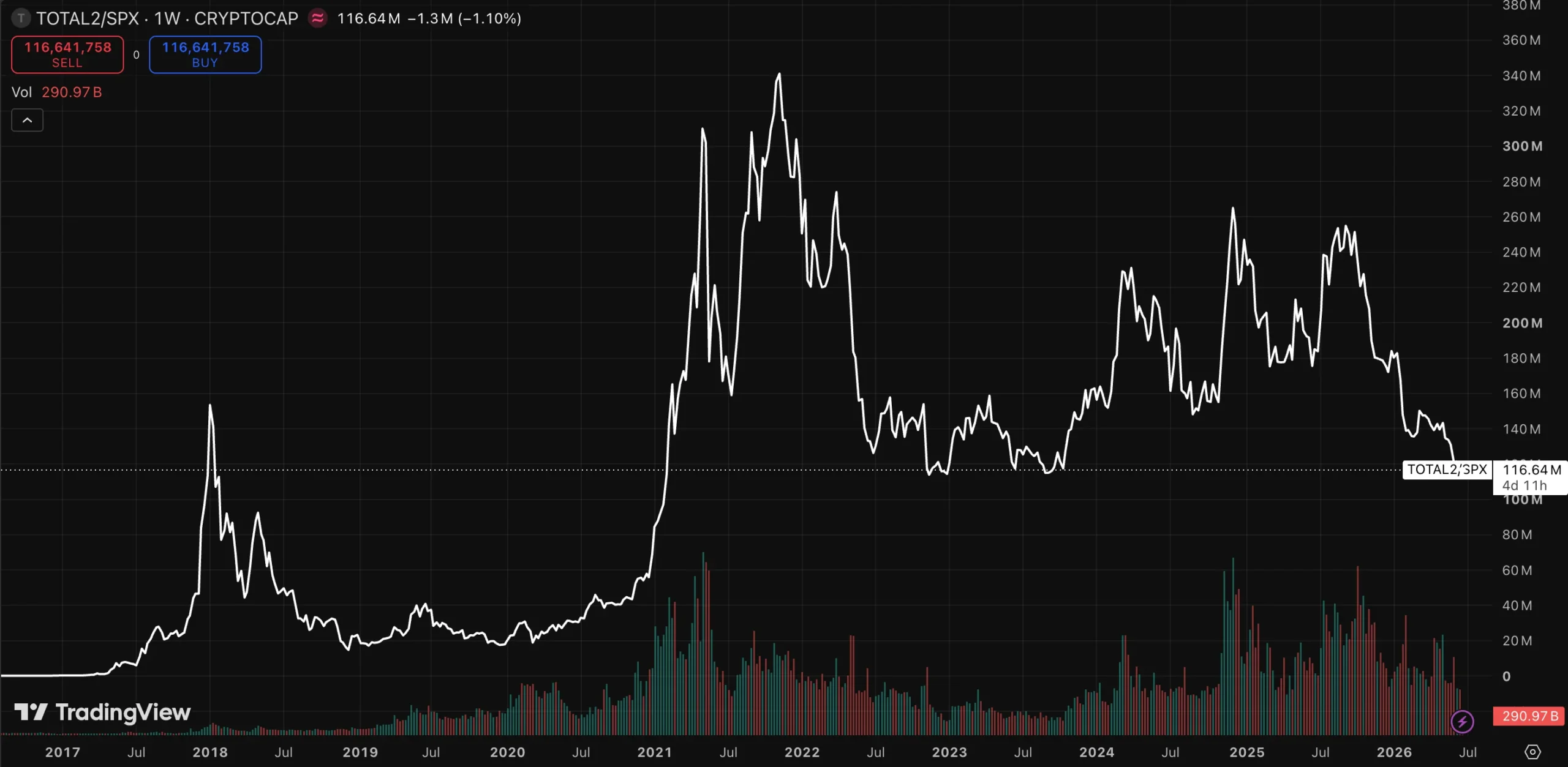
The two assets also behave very differently once they trade, and that gap is its own kind of risk. The chart below divides the total altcoin market cap (TOTAL2) by the S&P 500. The repeated boom-and-bust swings, vertical spikes followed by long drawdowns, show how much more volatile the token market is than broad equities. It is the extreme-beta picture sitting beneath the legal distinction: tokens don’t just carry different rights, they move on a different amplitude.
Regulation and Disclosure
This is where IPOs and ICOs diverge most, and where the picture has changed fastest. An IPO is a registered public securities offering. The company files with the SEC, publishes a prospectus, and takes on continuing disclosure duties. The framework is mature, the obligations are well understood, and the fraud protections, imperfect as they are, rest on decades of case law and enforcement.
ICOs are more variable. Whether a particular token sale is a securities offering depends on how the token is structured, sold, and promoted. The governing test is older than the internet: it comes from the 1946 Supreme Court case SEC v. W.J. Howey Co., which had nothing to do with technology and everything to do with oranges.
A Florida company had sold strips of citrus grove paired with a contract to tend and harvest the fruit, and the court ruled the package was an “investment contract,” a security, because buyers were putting money into a common enterprise expecting profit from someone else’s effort. That four-part Howey test still decides token cases today. The SEC applied it to crypto in its 2017 report on “The DAO,” and it remains the line any token sale has to clear, whatever the token is called.
Regulators were blunt about how they saw the early market. Testifying before the Senate Banking Committee in February 2018, then-SEC Chairman Jay Clayton offered a line that defined the era:
“I believe every ICO I’ve seen is a security.” | Jay Clayton, former Chairman, U.S. Securities and Exchange Commission
Regulatory factorIPOICORegistrationRegistered before the public saleMay or may not be registeredDisclosuresStandardized public filingsFormat and quality varyInvestor protectionsEstablished securities frameworkDepends on structure and jurisdictionLegal exposureTraditional securities complianceSecurities, commodities, AML/KYC, cross-borderFraud riskExists, but disclosure framework is matureHistorically a significant concernRegulatory factorRegistrationIPORegistered before the public saleICOMay or may not be registeredRegulatory factorDisclosuresIPOStandardized public filingsICOFormat and quality varyRegulatory factorInvestor protectionsIPOEstablished securities frameworkICODepends on structure and jurisdictionRegulatory factorLegal exposureIPOTraditional securities complianceICOSecurities, commodities, AML/KYC, cross-borderRegulatory factorFraud riskIPOExists, but disclosure framework is matureICOHistorically a significant concern
What has shifted: through 2025 and into 2026, U.S. regulators stepped back from the enforcement-first posture of the prior years. The SEC dropped a string of crypto cases brought under former Chair Gary Gensler, stood up a Crypto Task Force, and, jointly with the Commodity Futures Trading Commission, issued a landmark interpretation on March 17, 2026.
That interpretation sorts crypto assets into five categories: digital commodities, digital collectibles, digital tools, stablecoins, and digital securities. The first four are generally treated as outside securities law, while digital securities (tokenized traditional securities) sit squarely within it. Crucially, the interpretation applies the Howey test rather than replacing it, and it makes clear that even a non-security token can still be sold “subject to an investment contract,” so the analysis still bites at the moment a project first sells tokens to raise money.
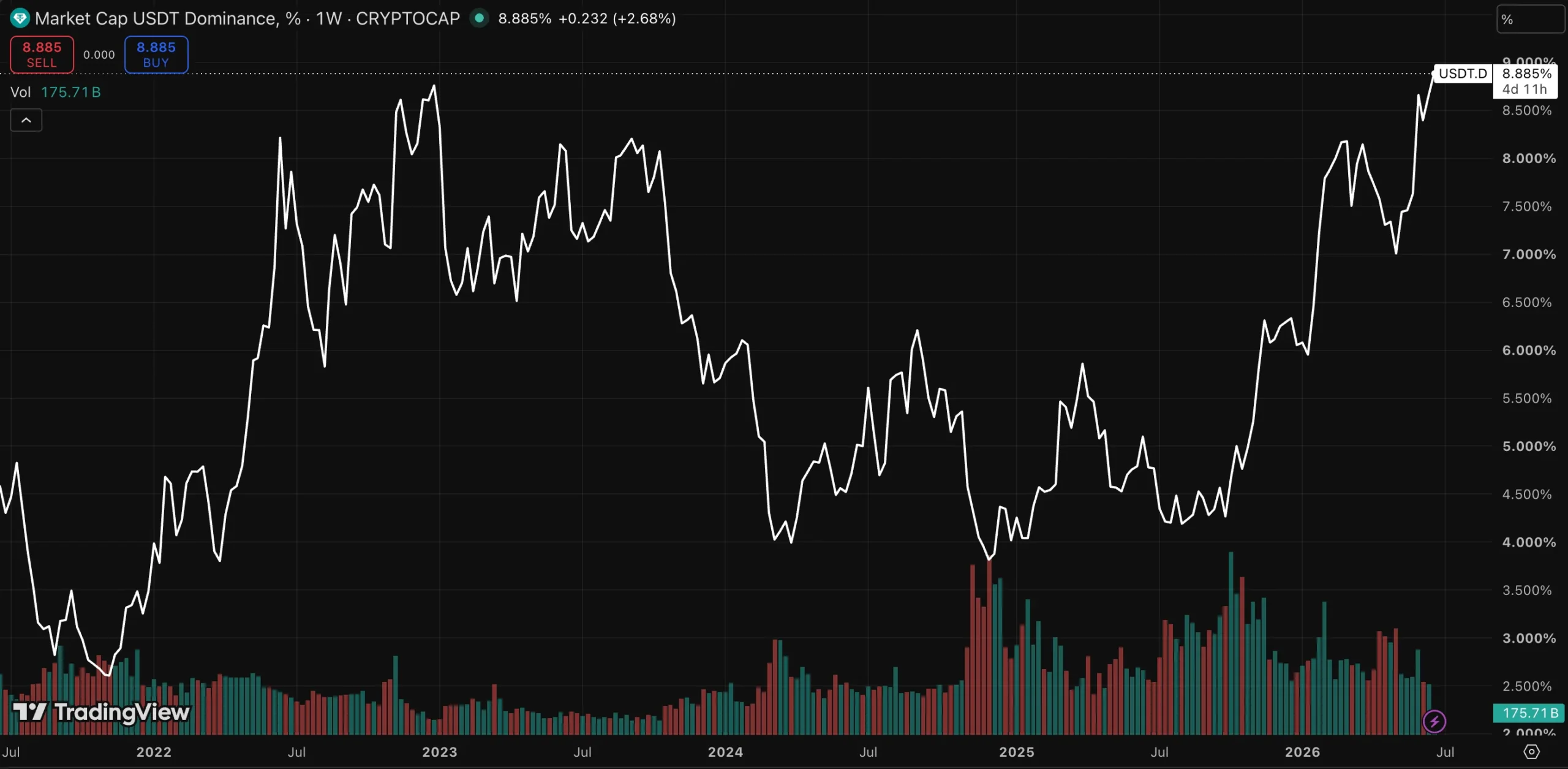
Stablecoins are one of those five buckets, and their growing footprint is easy to see in the market itself. The chart below tracks Tether’s (USDT) share of total crypto market value, which has trended up toward 9% and tends to spike whenever investors retreat from riskier tokens. That flight to digital cash is the crypto-native echo of money flowing into money-market funds during an equity selloff, and it is exactly the kind of behavior regulators had in mind when they carved stablecoins out as their own category.
Legislation is moving alongside the guidance. The Digital Asset Market Clarity Act (the CLARITY Act) passed the House 294–134 in July 2025 and cleared the Senate Banking Committee 15–9 in May 2026; by mid-2026 it sat on the Senate floor calendar, awaiting reconciliation with a parallel Senate Agriculture Committee bill and the House version before any final vote. If enacted, it would route most network-native tokens to the CFTC as digital commodities while keeping fundraising and investment-contract tokens with the SEC. It is not yet law, and the details may change.
For a beginner, the practical takeaway is unchanged by any of this: an ICO may or may not be a regulated securities offering, the answer turns on specifics, and “the rules are clearer now” is a long way from “there are no rules.” Before participating, find out whether the token is being treated as a security and whether the sale is registered or exempt.
ICOs, Token Sales, and Securities
“ICO” and “token sale” get used interchangeably, but token sale is the broader phrase, and the label a project picks does not settle the legal question.
Token sale typeWhat it meansKey questionICOA project sells tokens to raise fundsWhat rights do buyers actually receive?Token saleAny sale of tokensIs it public, private, or restricted?Utility token saleTokens meant for product or network useIs there real, working utility?Security token offeringA tokenized securities issuanceIs it registered or exempt?Private token roundTokens sold privately to select buyersWho can take part, and on what terms?Token sale typeICOWhat it meansA project sells tokens to raise fundsKey questionWhat rights do buyers actually receive?Token sale typeToken saleWhat it meansAny sale of tokensKey questionIs it public, private, or restricted?Token sale typeUtility token saleWhat it meansTokens meant for product or network useKey questionIs there real, working utility?Token sale typeSecurity token offeringWhat it meansA tokenized securities issuanceKey questionIs it registered or exempt?Token sale typePrivate token roundWhat it meansTokens sold privately to select buyersKey questionWho can take part, and on what terms?
A token marketed as a “utility token” can still be treated as a security if it is sold mainly as a bet on the team’s future efforts. What the token actually does carries the legal weight; the word on the label does not.
ICO vs IDO vs IEO vs STO
The crypto fundraising vocabulary expanded well beyond ICOs. The terms differ by where the sale happens, how it is vetted, and what the buyer gets.
TermFull namePlain meaningICOInitial coin offeringA project sells tokens directly or through its own saleIDOInitial DEX offeringA token sale run through a decentralized exchange or launchpadIEOInitial exchange offeringA token sale hosted and vetted by a centralized exchangeSTOSecurity token offeringA token offering deliberately structured as a securities offeringIPOInitial public offeringA company sells shares to the publicTermICOFull nameInitial coin offeringPlain meaningA project sells tokens directly or through its own saleTermIDOFull nameInitial DEX offeringPlain meaningA token sale run through a decentralized exchange or launchpadTermIEOFull nameInitial exchange offeringPlain meaningA token sale hosted and vetted by a centralized exchangeTermSTOFull nameSecurity token offeringPlain meaningA token offering deliberately structured as a securities offeringTermIPOFull nameInitial public offeringPlain meaningA company sells shares to the public
The difference between an IDO and an ICO is mostly venue: an IDO launches through a decentralized exchange or launchpad rather than the project’s own site, often with instant liquidity. An IEO shifts some vetting to a centralized exchange. An STO accepts up front that the token is a security and builds the offering around compliance. The trade-offs in custody, vetting, and regulatory exposure line up like this:
FormatVenue / hostWho vets the deal?Regulatory profileCustody of the tokenICOProject websiteOften no one (buyer beware)High risk of an unregistered securities offeringDirect to a self-custody walletIDODecentralized launchpadAlgorithmic criteria or community/DAO voteLargely unregulated DeFi layerClaimed via smart contract to a walletIEOCentralized exchangeThe exchange’s due-diligence teamBound by platform rules and local complianceHeld in the exchange accountSTORegulated security platformSEC/FINRA-registered broker-dealersCompliant securities issuance (Reg D, Reg S, Reg A+)Regulated custodian or approved walletFormatICOVenue / hostProject websiteWho vets the deal?Often no one (buyer beware)Regulatory profileHigh risk of an unregistered securities offeringCustody of the tokenDirect to a self-custody walletFormatIDOVenue / hostDecentralized launchpadWho vets the deal?Algorithmic criteria or community/DAO voteRegulatory profileLargely unregulated DeFi layerCustody of the tokenClaimed via smart contract to a walletFormatIEOVenue / hostCentralized exchangeWho vets the deal?The exchange’s due-diligence teamRegulatory profileBound by platform rules and local complianceCustody of the tokenHeld in the exchange accountFormatSTOVenue / hostRegulated security platformWho vets the deal?SEC/FINRA-registered broker-dealersRegulatory profileCompliant securities issuance (Reg D, Reg S, Reg A+)Custody of the tokenRegulated custodian or approved wallet
All four are crypto fundraising methods; they differ in venue, compliance, and what the buyer walks away holding.
Why Companies Use IPOs, and Why Crypto Projects Used ICOs
Companies go public to raise capital, give early investors and employees a way to cash out, establish a public valuation, gain visibility, and create stock they can use for acquisitions or compensation. The trade-off is real: a public company takes on reporting duties, public scrutiny, compliance costs, and constant market pressure.
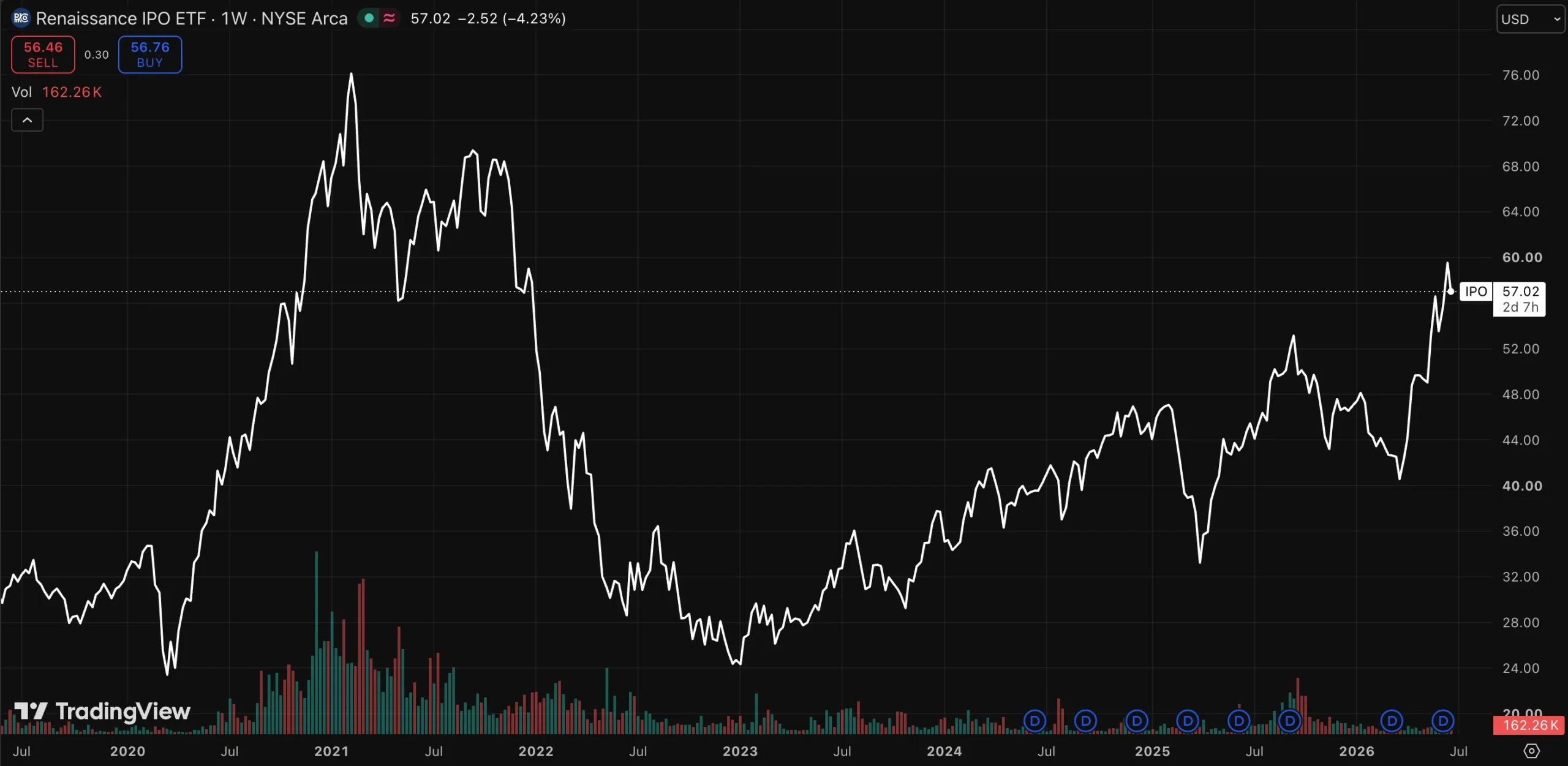
And going public is no guarantee the stock cooperates afterward. The chart below tracks the Renaissance IPO ETF, a basket of recently listed U.S. companies that serves as a rough baseline for how the newly public cohort trades. It ran to roughly $76 in early 2021, collapsed into the mid-$20s through 2022, and only clawed back toward $60 by 2026. This is concrete illustration of the article’s earlier point that recent listings can sit below their highs for years.
Crypto projects turned to ICOs to raise funds before or during a network launch, distribute tokens to early users, bootstrap an ecosystem with built-in incentives, and fund open-source development without the gatekeeping of venture capital or a traditional IPO.
Even Ethereum co-founder Vitalik Buterin, whose platform hosted most of the boom, saw both sides. He praised ICOs for opening up funding for open-source development, warned in 2017 that the market had inflated into a bubble, and at the height of the mania publicly begged people not to buy into token sales that flashed a selfie with him as fake endorsement.
The model became controversial for the same reasons it was popular: many projects raised money before they had a working product, disclosures ran from thorough to nonexistent, and buyers frequently had little recourse when things went sideways.
Risks of IPOs and ICOs
Neither structure guarantees a return. Both can lose value, and an ICO typically carries extra layers of technical, disclosure, and regulatory risk that a share offering does not.
RiskIPOICOValuationOffering price may be too highToken value may be purely speculativeBusiness / projectCompany may underperformProject may never launch or find usersLiquidityShares may drop or be locked upToken may never list or may trade thinlyDisclosureInvestors must read filings closelyDisclosures may be informal or incompleteRegulatoryPublic-market compliance obligationsSecurities, jurisdiction, and AML questionsFraudExists, but a regulated framework helpsHistorically a heightened concernTechnicalLow for sharesSmart-contract, wallet, and blockchain riskRiskValuationIPOOffering price may be too highICOToken value may be purely speculativeRiskBusiness / projectIPOCompany may underperformICOProject may never launch or find usersRiskLiquidityIPOShares may drop or be locked upICOToken may never list or may trade thinlyRiskDisclosureIPOInvestors must read filings closelyICODisclosures may be informal or incompleteRiskRegulatoryIPOPublic-market compliance obligationsICOSecurities, jurisdiction, and AML questionsRiskFraudIPOExists, but a regulated framework helpsICOHistorically a heightened concernRiskTechnicalIPOLow for sharesICOSmart-contract, wallet, and blockchain risk
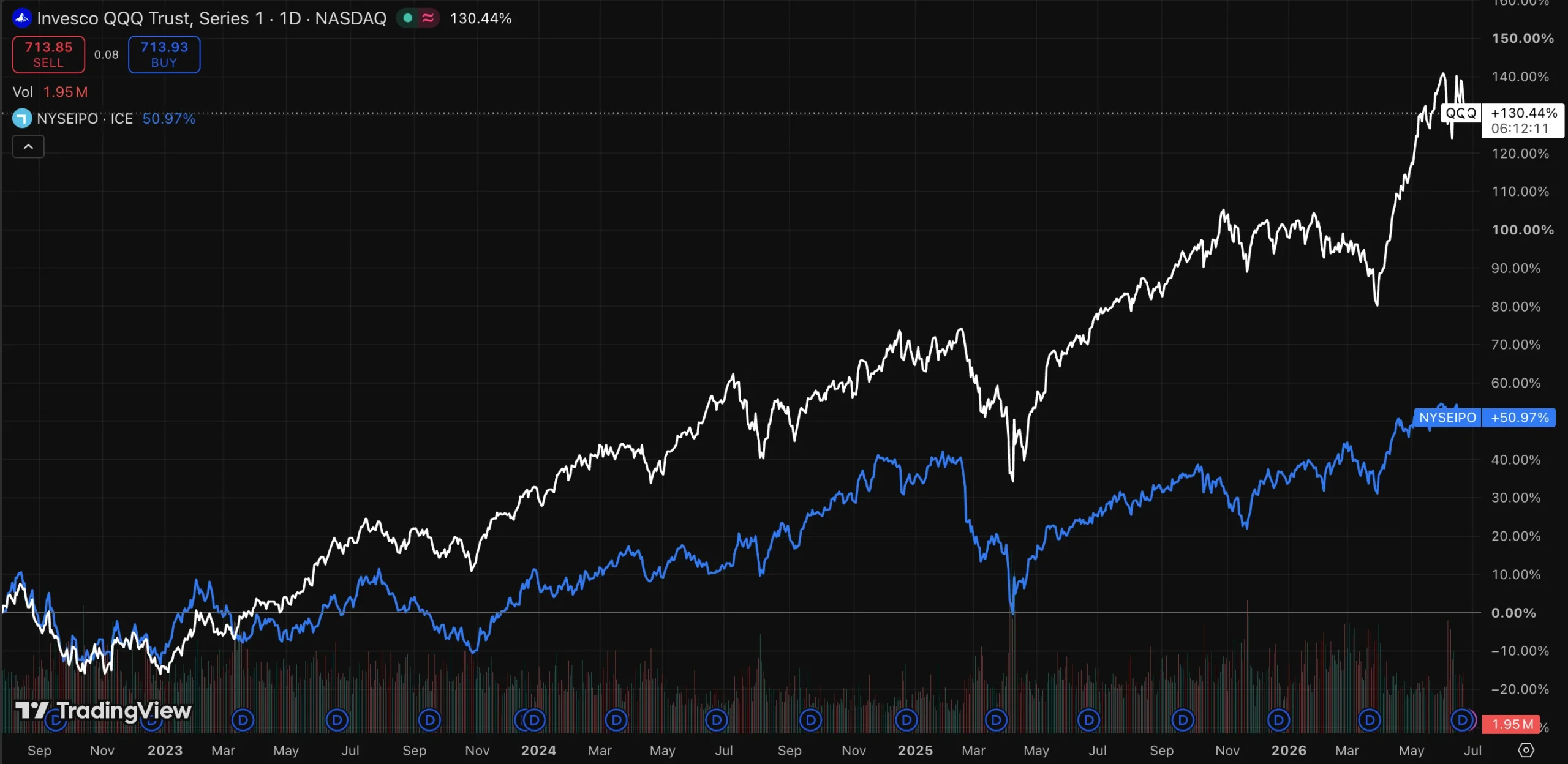
The valuation and performance risk on the IPO side is not abstract. The chart below sets the Nasdaq-100 (QQQ) against the NYSE index of recently listed companies. Over the window the established tech heavyweights climbed about 130%, while the basket of new listings managed only about 51%, a clean illustration of how freshly public stocks can carry more risk without delivering the matching reward of the incumbents that institutions already crowd into.
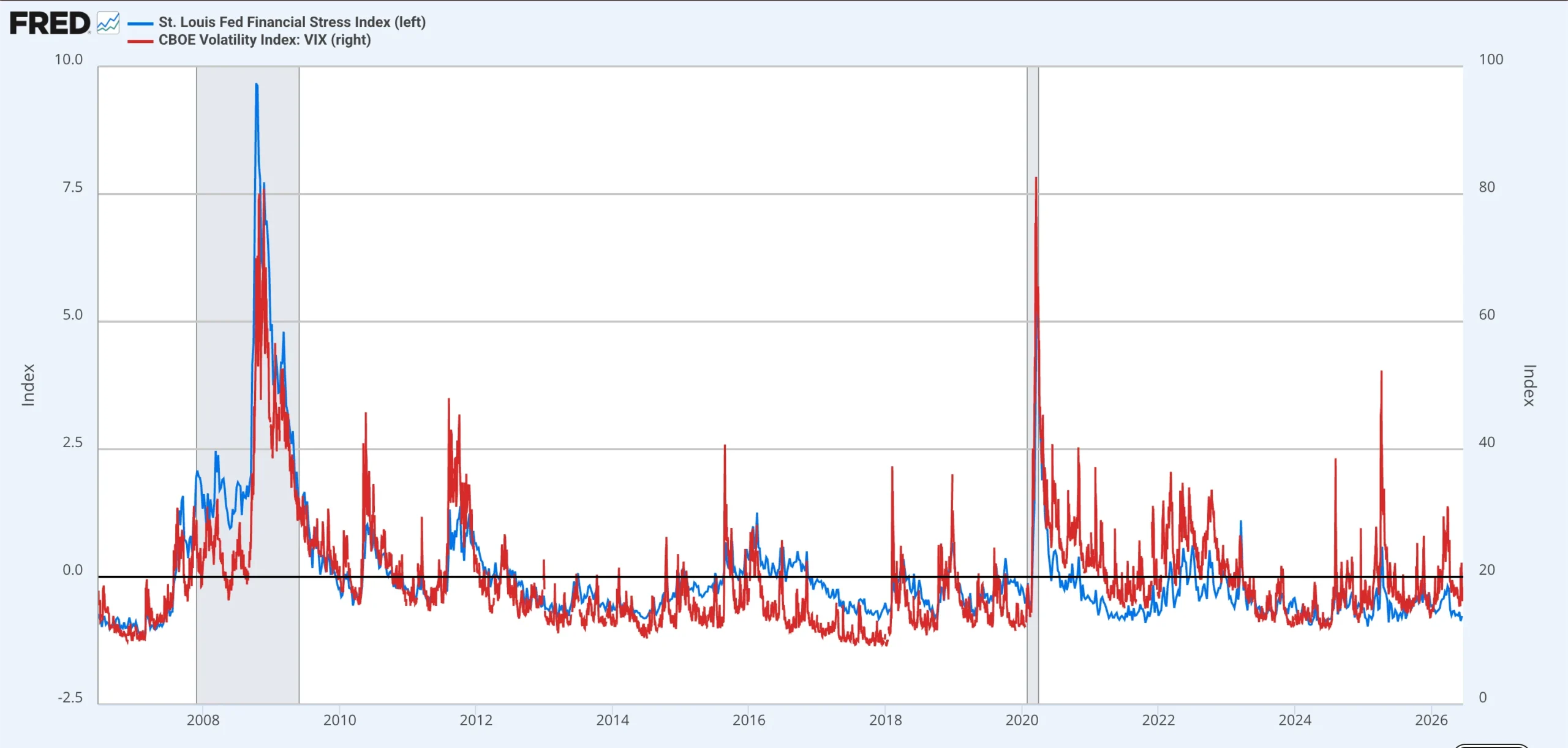
Both markets also sit inside a wider macro tide. When overall risk appetite is high, financial stress low relative to market volatility, IPO windows swing open and token sales find willing buyers; when that spread flips, both freeze almost in unison. The chart below captures exactly that swing in macro risk appetite, and it is the backdrop against which any individual IPO or ICO is priced.
How to Evaluate an IPO or ICO
Whether you are working through a 200-page IPO prospectus or a 15-page crypto whitepaper, run the offering through the same five-point check before committing a cent:
- Audit the enforceable rights: If this thing succeeds wildly or gets acquired, do you have a legal claim to anything (dividends, proceeds, a vote that counts) or only the “right” to post in a Discord channel? For an IPO that lives in the share class; for an ICO it lives in the token terms and the smart contract.
- Check the lockup or unlock schedule: For an IPO, when do insider lockups expire? For an ICO, study the token’s emission curve and fully diluted valuation, are early backers set to unlock a flood of tokens onto the market next month?
- Verify the legal entity: Is there a real incorporated company with a headquarters and accountable directors, or are you wiring money to a pseudonymous team behind an offshore shell?
- Scrutinize the use of proceeds: Are funds going into real product, infrastructure, and engineers, or into marketing, influencers, and propping up the token’s own price?
- Identify the regulatory backstop: If the team commits fraud and vanishes tomorrow, can you file a claim with a recognized securities regulator, or are you entirely on your own?
For an IPO, the prospectus answers most of these in one document. For an ICO, the answers are scattered across a whitepaper, a website, smart-contract code, and whatever legal terms the project chose to publish, and the gaps in that record are themselves a warning sign.
Closing Thoughts
IPOs and ICOs both raise money from the public, but they give buyers very different things. An IPO usually sells company shares through a regulated process, giving investors equity rights and standardized disclosures. An ICO sells digital tokens, and those tokens may or may not provide ownership, utility, governance, liquidity, or legal protection.
The most important questions are what the buyer actually receives, what rights are enforceable, how the offering is regulated, and what disclosures support the sale. A prospectus, audited financials, token terms, smart-contract details, unlock schedule, and legal structure all matter more than the headline opportunity.
For investors, the safest approach is to treat both IPOs and ICOs as risk assets, not guaranteed early-access wins. IPOs can disappoint despite regulation, and ICOs can carry extra risks around fraud, weak disclosure, technical failure, liquidity, and securities law.