TRON is a Layer-1 blockchain that hosts the largest supply of Tether’s USDT stablecoin in the world and processes roughly 8 million transactions per day, making it one of the busiest payment networks in crypto. Founded in 2017 by Justin Sun and governed by TRON DAO since 2021, the network has evolved from a content-focused platform into the foundational rail for stablecoin transfers, with a growing ecosystem spanning DeFi, NFTs, decentralized applications, and AI agent infrastructure.
This guide explains what the TRON blockchain is, how the TRX cryptocurrency works, and how to use the network. By the end, you will understand why TRON has become a major part of the decentralized web and how to get started with it yourself.
Key Takeaways
- TRON is a Layer-1 blockchain founded in 2017 by Justin Sun; mainnet launched in June 2018.
- TRX is the native cryptocurrency, used for transactions, staking, governance, and accessing network resources.
- TRON uses Delegated Proof-of-Stake (DPoS) with 27 Super Representatives, producing blocks every 3 seconds.
- The network hosts the largest stablecoin supply of any blockchain (~$86.7B as of March 2026, per Artemis Analytics), with USDT making up roughly 98.6% of that.
- TRON’s energy and bandwidth fee model makes USDT transfers cost $1 to $4 typically, near zero with staked TRX or energy rental services.
- The ecosystem includes DeFi (JustLend, SunSwap), NFTs (APENFT, TRC-721), dApps (gaming, content, social), and emerging AI agent infrastructure (B.AI, Bank of AI).
- TRON processes more real-world stablecoin payment volume than any other blockchain, particularly in cross-border corridors.
- TRX has deflationary mechanics through smart contract fee burns introduced in TIP-51 (April 2021).
What Is TRON?
TRON is a blockchain platform designed to run decentralized applications (dApps), execute smart contracts, and host digital assets like stablecoins and NFTs. It operates as a Layer-1 blockchain, meaning it has its own independent network rather than running on top of another blockchain like Ethereum.
The network supports a wide range of applications, from decentralized exchanges to stablecoin payments to digital collectibles. Its native cryptocurrency, TRX, powers transactions, staking, and governance decisions through TRON DAO, the community organization that took over network governance in December 2021.
What distinguishes TRON from many other blockchains is its focus on practical payment infrastructure. The network processes large volumes of stablecoin transactions daily, hosts the largest supply of Tether’s USDT in the world, and has become a key rail for cross-border value transfer in markets where traditional banking is slow or expensive. Smart contracts on TRON are also compatible with Ethereum tools through the TRON Virtual Machine (TVM), making it easy for developers familiar with Ethereum to build on TRON.
The Origin Story: From Content Platform to Payment Network
TRON’s story spans nearly a decade of crypto history. Here is the timeline that shaped where the network is today.
- 2017: Justin Sun founded TRON; the initial coin offering (ICO) raised $70 million, with an initial vision centered on decentralized content and entertainment.
- 2018: TRON launched its mainnet in June, migrating from being an Ethereum ERC-20 token to its own independent blockchain. In July, TRON acquired BitTorrent, one of the world’s largest peer-to-peer file sharing networks, bringing millions of users into the broader ecosystem.
- 2019: The TRC-20 token standard launched, enabling developers to issue stablecoins and other tokens on TRON. This standard would become foundational to TRON’s later role as a stablecoin hub.
- 2020: The DeFi ecosystem expanded with the launch of JustLend (lending) and JustSwap (decentralized exchange, later evolved into SunSwap).
- 2021: TRX transitioned to a deflationary token in April through TIP-51, which burns a portion of smart contract fees. In December, TRON achieved full decentralization, with governance passed to TRON DAO and the community.
- 2024: The T3 Financial Crime Unit launched in partnership with Tether and TRM Labs to address illicit activity on the network.
- 2026: TRON’s AI ecosystem launched with B.AI and Bank of AI; TRON joined Mastercard’s Crypto Partner Program; the network continued its dominance as the world’s leading stablecoin transfer rail.
The arc is straightforward: TRON started as a content platform, became the dominant network for stablecoin transfers, and is now positioning itself as infrastructure for the AI agent economy.
How TRON Works
Under the hood, TRON is built around three core technical components: a consensus mechanism (how the network agrees on transactions), a smart contract environment (how applications run on the chain), and a layered architecture (how data and applications are organized).
Delegated Proof-of-Stake (DPoS) Consensus
TRON uses Delegated Proof-of-Stake, a consensus mechanism where TRX holders vote for a small group of validators (called Super Representatives) to produce blocks and secure the network.
- 27 Super Representatives produce blocks in rotating order
- Each block is produced approximately every 3 seconds
- Super Representative elections happen continuously, allowing the community to vote out underperformers
- Transactions reach practical finality at the block level (single-block soft finality)
This design optimizes for speed and low costs. The trade-off is fewer validators than networks like Ethereum (which has hundreds of thousands of validators) or Bitcoin (which uses open mining participation).
The TRON Virtual Machine (TVM)
The TVM is TRON’s smart contract execution environment. It is compatible with Ethereum’s EVM (Ethereum Virtual Machine), meaning developers can write smart contracts in Solidity (Ethereum’s primary smart contract language) and deploy them on TRON with minimal changes. This compatibility has helped TRON attract dApp developers familiar with the Ethereum stack.
TRON’s Three-Layer Architecture
TRON organizes its technology stack into three layers:
- Storage layer: Stores blockchain data, transaction history, and the current network state
- Core layer: Handles consensus, smart contract execution, and account management
- Application layer: Hosts the dApps, wallets, and developer tools users interact with
This separation lets each layer be improved independently as the network evolves.
Design Tradeoffs
Every blockchain makes design tradeoffs. TRON’s choice to use 27 Super Representatives prioritizes high throughput, fast finality, and low fees over the larger validator sets used by networks like Ethereum. The result is a network optimized for cheap, fast, predictable transactions, which is why TRON has become the dominant chain for stablecoin transfers and high-volume payments. Users who prioritize maximum validator decentralization may prefer networks with larger validator sets; users who prioritize fast, cheap payments often choose TRON’s model.
Understanding the TRX Cryptocurrency
TRX is the native cryptocurrency of the TRON network, and it serves several functions:
- Payments: Send and receive value on the network
- Resource access: Stake TRX to obtain energy and bandwidth for transactions (more on this below)
- Smart contract execution: TRX powers transaction fees when not using staked resources
- Governance voting: TRX holders stake to gain voting power and elect Super Representatives
- DeFi participation: Use TRX in lending protocols, decentralized exchanges, and yield products
TRX has a maximum supply of approximately 100.85 billion tokens, with a circulating supply of roughly 88 to 95 billion as of mid-2026. The token has been deflationary since April 2021, when TIP-51 introduced a mechanism that burns a portion of smart contract execution fees. Additional burn mechanisms have been added through subsequent governance proposals.
Readers interested in monitoring broader network activity (changes in TRX supply, staking participation, and token burns) can explore the public analytics on the TRONSCAN charts dashboard.
How TRON’s Fee Model Works: Energy and Bandwidth Explained
TRON’s fee model is one of the network’s most distinctive features and the reason USDT transfers can cost a fraction of what they cost on Ethereum. Yet most explanations of TRON fees stop at “low fees” without explaining how the system actually works. Here is the breakdown.
Every transaction on TRON consumes two types of resources:
- Bandwidth: Used for simple transactions like sending TRX. Each TRON account receives approximately 600 bandwidth points per day for free.
- Energy: Required for smart contract execution. Since USDT on TRON is implemented as a TRC-20 smart contract, sending USDT consumes energy.
Users have two primary ways to obtain these resources:
- Stake TRX: Freeze (stake) TRX to earn energy and bandwidth allocations daily. With enough staked TRX, transactions can be near-zero cost.
- Burn TRX: Pay TRX directly per transaction without staking. A typical USDT transfer costs $1 to $4 through this method.
A third option has emerged: third-party energy delegation services like TronZap, a member of the TRON Builders League (TBL). These services let users rent energy on demand without staking, often at lower cost than burning TRX directly.
Users who want to estimate the amount of TRX required to generate a specific amount of energy or bandwidth can use the TRON resource calculator, which provides real-time estimates based on current network conditions.
The Energy Unit Price was reduced in August 2025 through Proposal #104, halving the TRX cost for USDT transfers. The fee model continues to evolve through community governance proposals.
The TRON Ecosystem: DeFi, NFTs, Stablecoins, and dApps
TRON hosts thousands of decentralized applications across multiple categories. The ecosystem can be organized into four main pillars.
Stablecoins on TRON
TRON is the world’s largest stablecoin transfer network by transaction volume. As of March 2026, TRON hosts approximately $86.7 billion in stablecoin supply, with Tether’s USDT accounting for roughly 98.6% of that (per Artemis Analytics data).
USDT on TRON uses the TRC-20 token standard. The reason TRON dominates USDT transfers comes down to economics: low fees, fast settlement, and deep support across every major centralized exchange. USDT on TRON moved roughly $2 trillion in volume during Q1 2026 alone.
TRON also hosts:
- USDD: TRON’s overcollateralized native stablecoin
- stUSDT: A yield-bearing wrapped USDT product that pays returns from short-duration U.S. Treasury bills
Important note: USDT on TRON is the same dollar as USDT on Ethereum, BNB Chain, or any other network where Tether issues it. The token issuer is identical. Only the underlying blockchain rails differ.
DeFi on TRON
TRON has built one of the largest DeFi ecosystems by total value locked (TVL), behind only Ethereum. Major protocols include:
- JustLend DAO: The largest lending and borrowing protocol on TRON, allowing users to earn yield on deposits and take collateralized loans
- SunSwap: TRON’s main decentralized exchange (DEX) for swapping TRC-20 tokens
- SunPerp: Perpetual futures trading platform
- SunPump: Memecoin launchpad that gained traction in 2024
DeFi yields on TRON tend to be lower than those on smaller chains but more stable, reflecting the maturity of the protocols.
NFTs on TRON (TRC-721)
TRC-721 is TRON’s standard for non-fungible tokens, equivalent to Ethereum’s ERC-721. Minting NFTs on TRON is significantly cheaper than on Ethereum, making it accessible for smaller creators and high-volume collections.
The main TRON-aligned NFT initiative is APENFT, which bridges TRON and Ethereum NFT activity. TRON NFTs cover the standard categories: digital art, gaming items, music collectibles, and ticketing applications.
Decentralized Applications (dApps)
dApps are applications that run on a blockchain rather than centralized servers. TRON hosts thousands of dApps across DeFi, gaming, content sharing, social, and utility categories.
- TronLink is the most widely used wallet interface for accessing TRON dApps
- BitTorrent File System (BTFS) provides decentralized storage, leveraging the BitTorrent network TRON acquired in 2018; many TRON dApps use BTFS for off-chain content storage
Readers can browse current TRON dApp activity on data aggregator dashboards to see what is most popular at any given time.
TRON’s AI Ecosystem (Emerging in 2026)
A newer piece of the TRON story is the network’s emerging AI agent infrastructure. As AI agents (autonomous software that can take actions independently) move from research projects to real applications, they need payment rails designed for machines rather than humans. TRON has built several components for this:
- B.AI: A consumer-facing platform giving users and AI agents access to top-tier AI models with crypto-based payments. Justin Sun is publicly listed as an advisor.
- Bank of AI: The developer infrastructure layer, including agent identity (TRC-8004), payment protocols (x402), an agent-wallet SDK, and a composable “skills” system that connects agents to TRON DeFi protocols.
- TRON AI Fund: Over $1 billion committed to early-stage projects building the agent economy across identity, payment rails, real-world assets, and developer tooling.
TRON’s existing properties (low fees, fast settlement, large USDT supply) fit machine-to-machine payment needs without having been designed specifically for AI agents.
TRON for Real-World Payments and Remittances
Beyond crypto-native applications, TRON has become one of the most widely used networks for real-world cross-border payments. The network processes more USDT transfer volume than any other chain, with particular adoption in emerging markets where bank rails are slow or expensive.
Common corridors where TRON-USDT sees heavy use include Latin America, Sub-Saharan Africa, the Middle East, and Southeast Asia. Workers in countries with restrictive banking systems use USDT on TRON to send money home, businesses use it to pay international suppliers, and freelancers use it to receive payments from clients abroad.
The compliance side has matured alongside this growth. The T3 Financial Crime Unit, a joint initiative of TRON, Tether, and TRM Labs, launched in 2024 to address illicit activity on the network and has frozen hundreds of millions of dollars in flagged assets since. Mastercard added TRON to its Crypto Partner Program in early 2026.
TRON in the Regulatory Landscape
Stablecoin and blockchain regulation matured significantly through 2025 and 2026. The most important developments for TRON users:
- The GENIUS Act: Signed into U.S. law on July 18, 2025, this is the first comprehensive federal regulatory framework for payment stablecoins. It provides the regulatory foundation that USDT and other dollar-backed stablecoins operate within in the United States.
- MiCA (Markets in Crypto-Assets): The European Union’s parallel framework, governing stablecoin reserves, issuer authorization, and operational requirements.
- T3 Financial Crime Unit: TRON’s industry compliance initiative with Tether and TRM Labs.
The direction is toward formal regulation rather than ambiguity. For TRON users, the practical effect is that the stablecoins they hold and transfer (especially USDT) increasingly operate under defined regulatory frameworks rather than in a gray zone.
How to Get Started With TRON
Here are the practical steps to start using TRON, whether you want to hold TRX, send USDT, or interact with dApps.
How to Set Up a TRON Wallet
- Choose a wallet:
- Self-custody multi-chain: The Bitcoin.com Wallet supports TRX storage with a beginner-friendly interface
- TRON-native: TronLink (the official TRON wallet, available as browser extension and mobile app)
- Multi-chain alternatives: Trust Wallet, Atomic Wallet
- Hardware wallets: Ledger Nano X or Ledger Stax for larger balances and long-term storage
- Download only from official sources (verify the URL carefully to avoid phishing scams)
- Create your wallet and save the seed phrase securely (write it down physically, never store digitally, never share with anyone)
- Note your TRX address (always starts with capital “T” and is exactly 34 characters)
How to Buy TRX
- Choose an exchange. Major options include Bitcoin.com, Binance, Coinbase, Kraken, and most other major centralized exchanges
- Create an account and complete KYC verification
- Deposit fiat (USD, EUR) or crypto (BTC, ETH, USDT)
- Buy TRX from the exchange’s spot market
- Withdraw TRX to your wallet using the TRON (TRC-20) network
Always verify the withdrawal network is “TRON” or “TRC-20” before sending. Selecting the wrong network (Ethereum, BNB Chain) means lost funds.
How to Send USDT on TRON
- Ensure you have enough TRX for fees, or have staked TRX with energy available (or rent energy through a service like TronZap)
- Open your TRON wallet and select USDT (TRC-20)
- Paste the recipient’s TRON address (must start with “T”)
- Double-check that the address is on the TRON network, not Ethereum or BNB Chain
- Confirm the transaction. Settlement happens in approximately 3 seconds
Sending to a wallet that has never received TRX or USDT before will incur a one-time account activation cost (~1 TRX).
How to Stake TRX
- Open your TRON wallet
- Navigate to the staking section (called “Stake 2.0”)
- Choose how much TRX to stake (no minimum required)
- Select what resource you want to earn: energy (for smart contract use) or bandwidth (for simple transfers)
- Cast votes for Super Representatives to earn voting rewards (typically around 4-5% annualized)
- Unstaking has a 14-day cooldown period before TRX becomes spendable again
TRON vs Other Blockchains
How does TRON compare to other major Layer-1 blockchains? Here is a side-by-side breakdown.
FeatureTRONEthereumSolanaBNB ChainConsensusDPoS (27 SRs)PoS (hundreds of thousands of validators)PoH + PoSPoSABlock time~3 seconds~12 seconds~400ms slot / 12.8s finality~3 secondsTypical USDT transfer fee$1 to $4 (near zero with staking)$0.40 to $5 typicalFractions of a centLow centsStablecoin supply hosted~$86.7B (Artemis, March 2026)~$168.7BGrowing rapidlySignificant presenceEVM-compatibleYes (via TVM)NativeNoYesBest forStablecoin transfers, payments, high-volumeInstitutional DeFi, complex smart contractsHigh-frequency micropaymentsMulti-purpose, BNB ecosystem
Each network has its strengths. TRON’s combination of low fees, fast settlement, and deep USDT liquidity makes it a practical choice for stablecoin payments and cross-border transfers. Ethereum remains the default for complex DeFi and institutional applications, while Solana suits high-frequency, low-value activity. For most beginners getting started with stablecoin transfers or simple dApp activity, TRON offers one of the easiest entry points.
Conclusion
TRON evolved from a content platform into one of the most widely used blockchain networks in the world, particularly for stablecoin payments. Its combination of low fees, fast settlement, deep stablecoin liquidity, and a growing ecosystem (DeFi, NFTs, AI agent infrastructure) has made it foundational to the real-world crypto economy. Whether you are sending USDT across borders, exploring DeFi yields, minting NFTs, or just learning what a blockchain is, TRON is one of the networks that is hard to ignore in 2026.
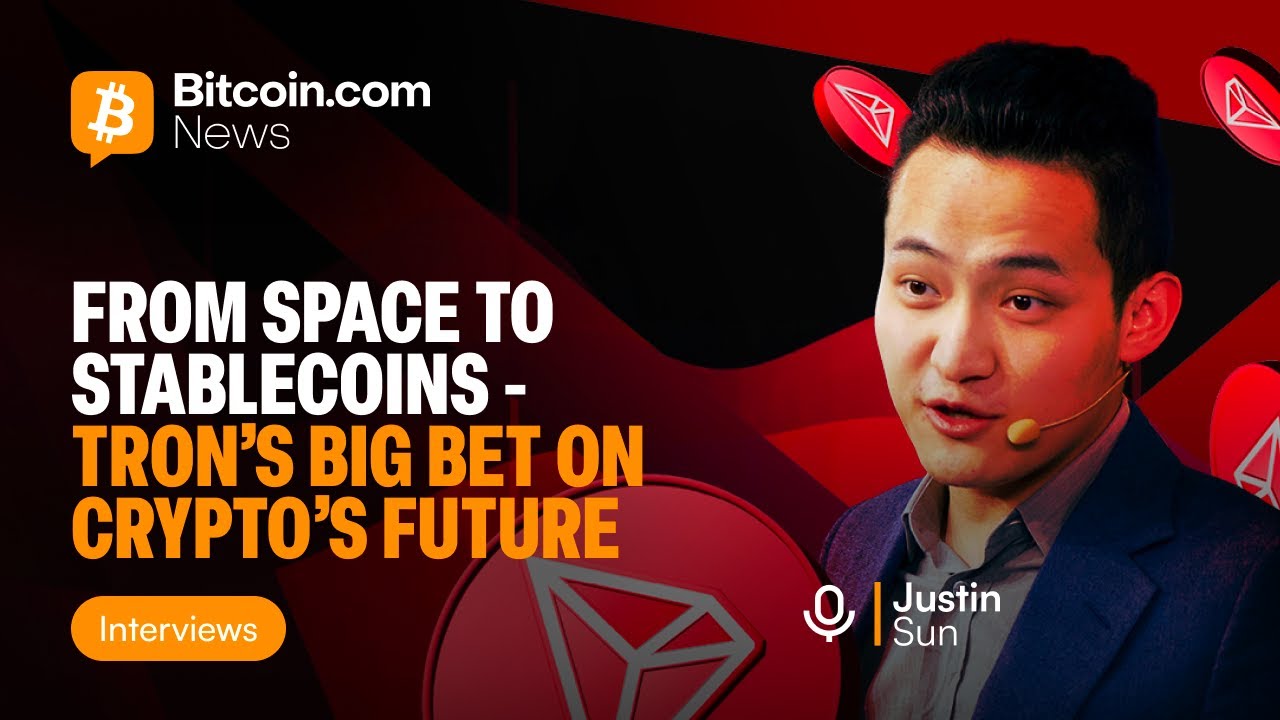
Interview with Tron Founder Justin Sun
Bitcoin.com spoke with Justin Sun, founder of TRON DAO and advisor to BitTorrent and HTX, about TRON’s role in the global crypto ecosystem and the network’s growth as a settlement layer for stablecoins.
In the interview, Sun discusses why TRON has become a major network for stablecoin transactions, his views on institutional crypto adoption, and broader trends shaping the digital asset market, including perpetual futures trading and global competition between Asia and the United States. The conversation also touches on Sun’s personal outlook on technology, innovation, and long-term visions for the future of digital assets.